

A jewelry house… that has always spoken the language of time
Tiffany & Co. and Watchmaking – In Europe, Tiffany & Co. is often associated with a specific image: that of a major American jeweler, embodied by diamonds, its iconic jewelry box, and a culture of gift-giving. However, theHouse's history is not limited to the brilliance of gemstones. For over 175 years, Tiffany has maintained an ongoing dialogue with watchmaking, a field where technical excellence, precision, and durability are as important as style.
To say that Tiffany is "returning" to watchmaking would therefore be a strategic misinterpretation. The term implies a parenthesis, an absence, an opportunistic detour. Yet the brand is seeking, on the contrary, to establish an idea of continuity:
It is not a territory conquered late in the game, but an ancient, sometimes overlooked, component of a larger heritage. The challenge is not simply to exist in a showcase, but to exist in the minds of collectors and discerning enthusiasts, where credibility is forged.
This nuance is crucial. In the luxury sector, watchmaking is a discipline where legitimacy cannot be decreed. It is proven through references, carefully chosen objects, industrial choices, and a consistent brand architecture. And above all, it is told through storytelling. Storytelling is not a veneer: it is a tool for interpretation that allows us to connect the DNA of a Maison to a product whose value depends as much on emotion as on proof.
Why has Europe long underestimated Tiffany watchmaking?

Tiffany's paradox lies in its renown. When you are globally identified with jewelry, watchmaking risks becoming a mere "side project" in the public's perception. In Europe, where watchmaking history is often written in Swiss dialect and discussed within connoisseur circles, non-Swiss brands must be even more transparent to be taken seriously. Adding to this cultural barrier is the reality of distribution: for years, Tiffany's influence has been more pronounced through its jewelry than through a structured and easily understood watchmaking presence, especially compared to specialized players.
Europemarket where benchmarks are highly codified. Calibers, finishes, movement origins, in-house production capabilities, and mastery of complications are readily compared. A Swiss watchmaker can boast generations of workshops, a tradition of chronometry, and a rich manufacturing history. For a jewelry house, even a prestigious one, the equation is different: it must translate mastery of materials and design into horological language without giving the impression of simply placing a dial on a piece of jewelry.
Finally, European collective memory has its habits. It spontaneously associates watchmaking with Geneva, the Jura region, the Vallée de Joux, and the names that have shaped the desire for fine timepieces. Tiffany, despite its history, has often been viewed as "American," and therefore outside this continental narrative. It is precisely this bias that the Maison seeks to correct, not through a radical break, but through a patient demonstration: the chronology exists, the objects exist, and they deserve to be re-examined.
A market where watchmaking concentrates desire, margins and prestige
If watchmaking attracts so many major luxury brands, it's not simply to complement their existing offerings. It's because a watch is an object of all-encompassing desire: it combines the intimate and the visible, technology and storytelling, everyday wear and collectability. It's also a category where value is maintained differently, with high prices coexisting with controlled production volumes. At a time when consumers are seeking meaningful pieces, the watch remains a symbol of achievement, taste, and culture.
In this arena, the competition is twofold. On one side, the Swiss watchmakers, bolstered by their historical legitimacy, their calibers, their networks of specialized retailers, and a close connection with collectors. On the other, the jewelry houses that have successfully established themselves as credible watchmakers, like Cartier, Bulgari , or Van Cleef & Arpels, each with its own distinct approach: iconography, mechanical prowess, artistic craftsmanship, jewelry complications, or a deliberate hybridization of jewelry and timekeeping instruments.
For Tiffany, watchmaking then became a strategic territory: it allowed them to broaden the brand's expression beyond jewelry, establish enduring " icons ," and cultivate a narrative of moving upmarket. But this ambition required playing by demanding rules: demonstrating substance, structuring collections, delivering on a promise of quality, and ensuring price consistency in line with European expectations.
Historical continuity: the power of a narrative that doesn't resemble a "comeback"
The choice of words is revealing: speaking of "reactivating" a history rather than "returning" to watchmaking. In the luxury sector, perception often precedes experience. Even before trying on a watch, the client already has an implicit opinion about the Maison's legitimacy. The heritage narrative serves to reduce this doubt, not by forcing admiration, but by re-establishing a logical thread. If Tiffany has a watchmaking history spanning more than 175 years, then the contemporary object no longer appears as a marketing whim: it becomes the actualization of a tradition.
This narrative works all the better because it fits into a broader dynamic of luxury: the era is no longer one of disconnected innovation, but of contextualized innovation. The houses that succeed are those that know how to connect a new form to a memory, a code, an archive. Tiffany doesn't need to borrow the history of others. It must make its own visible, understandable, and above all, European in its storytelling: precise, dated, documented, without excessive emphasis.
An article published on April 20, 2026, by Alexis de Prévoisin emphasized this very point: the Maison is not seeking to reinvent itself against its past, but rather to remind everyone that this past has always included watchmaking. This approach is not simply a communication exercise. It influences how the collections are designed, how they are presented in boutiques, how sales staff are trained, and how questions from connoisseurs are answered.
From jewelry to watchmaking: how credibility is built

Watchmaking credibility rests on a foundation of evidence. A jewelry house already possesses considerable advantages: a sense of proportion, expertise in materials, aesthetic mastery, artistic crafts such as gem-setting, engraving, and enameling, and a natural affinity for gold, platinum, and diamonds. But watchmaking imposes a different kind of requirement, one that is more easily verifiable: movement architecture, tolerances, reliability, after-sales service, parts availability, and production consistency.
In Europe, watch enthusiasts seek simple answers to very specific questions. the watch Swiss made? What is the movement, and where does it come from? What is the quality of the finishing, the case, the dial, and the strap? Does the brand control its production volumes or is it entirely dependent on subcontractors? These are legitimate questions, because a watch isn't judged solely on first glance. It is judged by the test of time, in the most literal sense.
The challenge for Tiffany lies in translating its jewelry DNA into watchmaking language without betraying either. A watch that is too jewelry-like risks appearing decorative. A watch that is too technical, if it forgets the Tiffany signature, risks becoming anonymous. The most elegant path is that of coherence: a watch that embraces the jewelry heritage in its details, materials, and taste, while presenting a compelling horological architecture.
The product signals that really matter: design, movement, finish
In the luxury sector, the product itself is a message. It speaks for itself even before it's explained. To be credible in watchmaking, Tiffany must send immediately recognizable signals: an identifiable design, perceived quality in the cases and dials, meticulous ergonomics, and chromatic consistency where the famous blue is not a gimmick but a carefully chosen color scheme. The choice of materials also plays this role: steel, gold, platinum, and perhaps ceramic, not forgetting the jewelry-like dimension, which can be expressed through precise, never gratuitous, gem-setting.
The question of movement is fundamental. A caliber is not merely a technical component; it is a cultural statement. Watchmakers can collaborate with Swiss partners, develop specific movements, or gradually invest towards greater integration. For the European enthusiast, clarity is key: what is made where, by whom, and according to what standards. In a world saturated with storytelling, transparency becomes a form of luxury.
The finishing touches are another silent language. Beveling, polishing, satin-finishing, the quality of the hour markers, the precision of the assembly, the dial's appearance, the crispness of the typography: these details compose the connoisseur's experience. For Tiffany, moving upmarket means this precision. It's not about imitating the aesthetics of Swiss manufacturers, but about proving that the execution reaches a level consistent with the Maison's positioning. Luxury is less about effect than about mastery.
Facing off against Cartier, Bulgari and Van Cleef & Arpels: a battle of icons and expertise
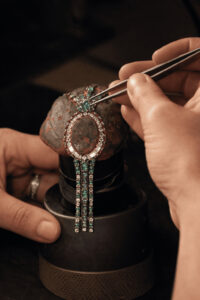
The most delicate territory for Tiffany isn't solely that of "purist" watchmakers. It also lies with jewelry houses already recognized as watchmakers in their own right. Cartier has built its horological authority thanks to shapes that have become classics, a culture of design, and an ability to transcend eras. Bulgari has demonstrated, in recent years, a spectacular mechanical ambition, particularly around records for thinness, while maintaining a Roman sensuality in its design. Van Cleef & Arpelshas established a poetic register where the métiers d'art and automata tell a different story of time.
These brands have one thing in common: they have created icons. In watchmaking, an icon isn't just a model that sells; it's an instantly recognizable form, a vocabulary that can be endlessly reinterpreted. For Tiffany, the European challenge is to establish a signature as clear as its blue. A watch that, from afar, says "Tiffany" without needing to spell it out in large letters.
The competition also hinges on the in-store experience. Jewelers have mastered theart of presentation, relationship, and service. But watchmaking demands a complementary skill: the ability to discuss power reserve, water resistance, adjustments, servicing, and complications. The European customer, sometimes more technically inclined, expects a conversation on equal footing. This requires a human investment: training, communication, and product knowledge.
The challenge for Swiss watchmakers: collectors, legitimacy, mechanical proof
Swiss watchmakers occupy a unique territory: they don't just sell watches, they sell a concept of time as heritage. They possess museums, archives, connections with specialized artisans, and a long-standing presence in collector circles. Faced with them, Tiffany must avoid two pitfalls. The first would be to try to gain acceptance by imitating their codes, at the risk of losing its distinctiveness. The second would be to downplay the importance of technical expertise, as if the prestige of jewelry alone were enough.
To convince collectors, a fundamental requirement must be met: consistency between price, quality, and rarity. A credible watchmaking strategy clarifies the offering, acknowledges its biases, and delivers on its promise over time. Distribution plays a crucial role here. A watch cannot be a mere accessory placed alongside jewelry; it must exist as a distinct category with its own service, its own sales pitch, and controlled availability.
The concept of "barriers" is illuminating. In Swiss watchmaking, barriers are technical (movements, components, adjustments), cultural (legitimacy, criticism, specialized media), and community-based (collectors, forums, retailers, independent watchmakers). To overcome these barriers, Tiffany must build bridges: industrial partners, a transparent approach, and timepieces significant enough to be discussed beyond the circles already devoted to the brand.
The LVMH effect: industrial synergies, premiumization, and retail power
Since joining theLVMH group, Tiffany has a key advantage few brands possess: an ecosystem capable of accelerating its watchmaking strategy without compromising its brand identity. Within a group where major names in jewelry and watchmaking coexist, the potential synergies are numerous: expertise, suppliers, quality standards, networks, and a culture of premiumization. This capacity for controlled industrialization is crucial, as watchmaking is a long-term business where investment is required before returns are seen.
Retail, in particular, is becoming a powerful tool. Conquering Europe is also achieved through its physical locations: boutiques capable of showcasing Tiffany watches in a cohesive environment, with displays that respect watchmaking traditions while maintaining jewelry elegance. The group's networks also allow for better structuring of after-sales service, team training, and consistent execution.


