Who is Meryll Rogge, the artistic director of Marni?

The timeline is now much clearer than it was when Meryll Rogge was appointed at Marni. The Belgian designer was officially chosen as the Milanese fashion house's creative director on July 15, 2025, a few weeks after Francesco Risso's departure. She has since presented her first collection for Marni, on February 26, 2026, during Milan Fashion Week.
The main piece of information to update in the original article concerns her first runway show. This is no longer a hypothesis linked to spring-summer 2026: Meryll Rogge's debut took the form of an autumn-winter 2026-2027, conceived as a reinterpretation of Marni's foundations rather than a dramatic break.
His arrival marks the beginning of a third major chapter in the brand's creative history, following those of its founder Consuelo Castiglioni and Francesco Risso. Rogge's project now consists of making Marni more accessible, more desirable, and more directly connected to the product, without erasing the eccentricity that has distinguished the house since 1994.
Born in Ghent, Belgium, Meryll Rogge belongs to that generation of designers trained in the Antwerp fashion ecosystem, where garment construction, visual research and individual expression occupy a central place.
She studied fashion design at theRoyal Academy of Fine Arts in Antwerp, before moving to New York and joining Marc Jacobs' design team. She stayed there for almost seven years, in an environment where artistic references, popular culture, and the sophistication of American ready-to-wear converged.
Upon returning to Belgium, she became head of women's design at Dries Van Noten. For four years, she participated in the development of the women's collections and also worked on the conceptualization of the house's beauty line.
In 2020, she launched her eponymous brand. Her collection is based on unexpected combinations of simple menswear, sophisticated evening wear, deliberately offbeat silhouettes, and a particular focus on knitwear. The designer received the Emerging Talent of the Year award at the Belgian Fashion Awards in 2021, followed by the Designer of the Year in 2024. Marni emphasizes that she is the first woman to have received this latter distinction.
The ANDAM Grand Prix, a major turning point for 2025
A few weeks before her appointment at Marni, Meryll Rogge won the ANDAM Grand Prix 2025 for her personal brand.
This award sends an important signal.ANDAM doesn't just recognize aesthetics or a successful collection. Its jury also evaluates a brand's consistency, its development potential, its business model, and the maturity of its entrepreneurial project.
The Meryll Rogge brand is described by the organization as a Belgian ready-to-wear label founded in 2020, offering a contemporary wardrobe built on surprising associations and a form of ambivalence between masculine and feminine.
This distinction boosted the designer's international visibility at a time when OTB was seeking a new direction for Marni. It also confirmed that Rogge could transcend the boundaries of an independent label to encompass a broader universe, including ready-to-wear, accessories, boutiques, image, and collaborations.
Why was Meryll Rogge chosen by Marni?
Meryll Rogge 's choice is based first and foremost on a linguistic affinity with the house.
Marni is associated with a fashion where color is never merely decorative. It structures the silhouette, creates contrasts, and transforms the perception of materials. From its inception, the house has also worked with unusual volumes, graphic prints, and a deliberately imperfect elegance.
Meryll Rogge also has a very personal way of using colors, textures, and shifts in proportion. Her collections can bring together an embellished cardigan, a deconstructed shirt, wide-legged trousers, or a piece from the sportswear vocabulary, without giving the impression of an artificial assembly.
This compatibility does not mean that the designer must reproduce the Marni of the 1990s or extend the work of Francesco Risso exactly. Rather, it offers her a foundation from which to build her own vocabulary.
Upon his appointment, Renzo Rosso, president of the OTB Group, highlighted his ability to reinterpret the brand's DNA in all its dimensions: accessories, interior design, communication, and special projects. This statement demonstrates that his role extends far beyond the design of clothing collections.
A sensitive succession after Francesco Risso
Francesco Risso's departure was announced on June 18, 2025 , after nearly ten years at the helm of Marni. Arriving in 2016, the Italian designer succeeded Consuelo Castiglioni . He gradually transformed the house's runway shows into collective, theatrical, and emotional experiences, while developing an aesthetic characterized by bold colors, free-flowing volumes, and artistic collaborations.
Under his leadership, Marni had strengthened its cultural identity. Its presentations sometimes resembled performances more than traditional fashion shows. This approach had allowed the brand to stand out in a market saturated with images, but it also posed a commercial question: how to convert this creative power into immediately identifiable and desirable pieces?
Meryll Rogge's work therefore does not begin on blank slate. She inherits a house with a strong artistic reputation, but one facing the need to transform this unique identity into a clearer product proposition. This change in artistic direction is also part of a broader renewal of OTB's portfolio, which also includes new directions at Maison Margiela and Jil Sander .
To understand the Italian group's strategy, our article on OTB's takeover of Viktor & Rolf offers additional insight into its interest in brands with a strong creative identity.
Meryll Rogge's first Marni collection
Meryll Rogge will present her first Marni collection on February 26, 2026, during Milan Fashion Week. The show will be dedicated to theFall/Winter 2026-2027 season.
The house summarizes this new direction with three words: "authentic," "sincere," and "real." It describes the project as a return to values and meaning, associated with the emergence of a new vocabulary within Marni's historical language.
Rogge's approach is not to reproduce the house's most famous collections. She works from personal memories, archival elements and signs immediately associated with Marni, then transposes them.
The result is based on several key ideas:
- altered proportions ;
- motifs treated as constructions;
- seams turned inside out or made visible;
- a confrontation between precious and industrial materials;
- a more flexible tailoring;
- a central stitch in the wardrobe;
- reworked historical accessories.
The scenography, developed with the design studio Formafantasma, extends this exploration. The space evokes a familiar interior, but one reorganized according to a slightly unstable logic. This tension between the recognizable and the unexpected corresponds precisely to Rogge's creative territory.
A return to the roots without the retro effect
Meryll Rogge's first show can be interpreted as a return to her roots, but it is not a nostalgic exercise. Marni was founded in Milan in 1994 by Consuelo Castiglioni. From its inception, the house has cultivated an aesthetic where sophistication depends neither on the rigidity of traditional tailoring nor on the classic codes of Italian glamour.
Its identity arises from a balance between:
- tactile materials;
- abstract prints;
- complex colors;
- enveloping volumes;
- graphic accessories;
- deliberately irregular details.
Meryll Rogge seems to want to recapture the relative simplicity of that first Marni, before accumulation, theatricality and maximalism became the most visible signs of the brand.
It does not eliminate eccentricity. It makes it appear gradually, in the turn of a texture, an incongruous pattern, a red belt, an oversized embroidery or an unexpected association between a parka and a more formal outfit.
This choice can make the brand more accessible without trivializing it. It also allows the construction of the garment to be put back at the heart of the narrative.
The signatures of the Fall/Winter 2026 collection
Material clashes
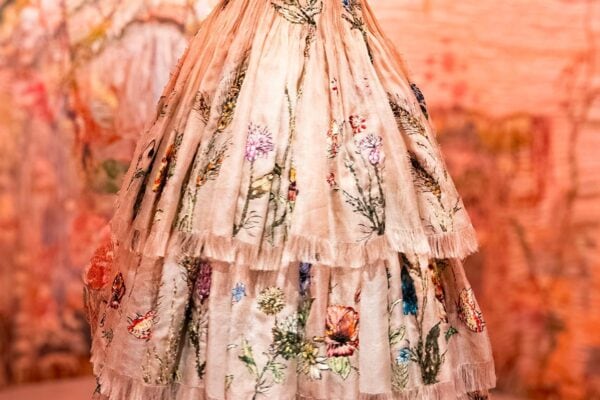
The collection combines thick leather with industrial wax, organza with technical materials, English embroidery with more utilitarian elements.
These contrasts create a tension between the precious and the ordinary. They correspond to Meryll Rogge's approach, who likes to bring together categories that are normally separate: daytime and evening wear, masculine and feminine, sophistication and functionality.
A more intimate mesh
Marni knitwear plays a significant role in this initial offering. It's not just spectacular or oversized; it also becomes tactile, protective, and relatively everyday.
Knitted cardigans, sweaters, and tank tops play with layering, decorative buttons, and changes in texture. Color is used sparingly within a more restrained palette than in some previous collections.
This restraint allows for a better perception of the structures and details.
Disproportionate
The shoulders are rounded, the coats envelop the body, and some skirts reintroduce a more assertive femininity.
However, the silhouette is never strictly classic. An overly large volume, an unexpected length, or a deliberately unconventional accessory disrupts the balance.
This work allows Rogge to avoid two pitfalls: too literal a tribute to the archives and a desire for rupture that would make Marni disappear behind his own name.
The Trunk bag is back
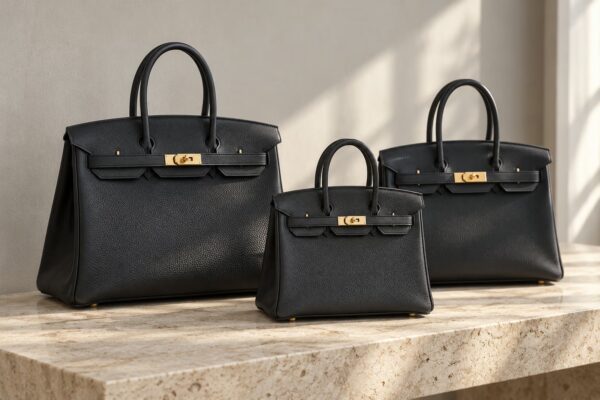
The Marni Trunk bag, one of the house's most recognizable accessories, reappears in a reworked version.
This return is a strategic choice. In the luxury sector, accessories often allow for the rapid translation of a new artistic direction. They are more easily recognizable, widely distributed, and marketable than a complete runway look.
By reinterpreting an existing icon rather than immediately launching a completely new bag, Meryll Rogge creates a visible continuity between the different chapters of the house.
A more wearable, but unconventional wardrobe
One of the challenges of this first collection was to reconcile Marni's artistic universe with a wardrobe capable of existing beyond the catwalk.
Rogge's response is not to produce neutral clothing. Rather, it favors a unique form of wearability : pieces that can fit into a real wardrobe while retaining a detail, texture, or proportion strong enough to be recognizable.
This approach is evident in protective coats, skirts, shirts, relaxed tailoring, and knitwear. Garments are not constructed as isolated objects. They must be wearable, layered, and reinterpreted.
This search for a balance between creativity and commercial efficiency is currently a common theme in many fashion houses. It also appears in our analysis of Pieter Mulier's appointment at Versace and in our analysis of the strategic role of a new artistic direction at Courrèges.
Why does color remain essential at Marni?
Reducing Marni to a colorful brand would be too simplistic. The house doesn't just use bright colors: it builds relationships between them.
For Meryll Rogge, color frequently functions as a memory, an accent, or a disruptive element. Red might appear on a belt, green in leather, yellow in technical clothing, or pink in an accessory.
In the first collection, the color palette is relatively restrained. This restraint seems deliberate. It allows the designer to lay the foundations of her style before exploring all its possibilities.
Colour has not disappeared. It has changed its function. It less systematically draws attention to the entire silhouette and sometimes becomes a precise, almost editorial, sign.
Should Marni become a product-centric brand again?
The appointment of Meryll Rogge can be interpreted as a desire to put the product back at the center of Marni's strategy.
The house possesses a powerful cultural universe, but this power must be embodied by clearly defined pieces. Effective artistic direction isn't measured solely by the reception of a fashion show. It must also produce lasting categories:
- a recognizable bag;
- a family of shoes;
- a signature knit;
- an identifiable coat;
- a pattern that can evolve over several seasons;
- a consistent look between the catwalk and the store.
The first collection offers several avenues, notably around Trunk, knitwear, red shoes, textured coats and clothing with visible seams.
The challenge now will be to extend these ideas. An iconic piece is not usually born in a single season. It becomes identifiable through repetition, evolution, and a consistent presence in campaigns, stores, and everyday use.
OTB's role in this new phase

Marni belongs to the OTB, founded by Renzo Rosso. The brand has been integrated into its ecosystem since 2013 and today has an international network of more than 90 stores, according to its institutional presentation.
OTB brings together brands with particularly strong identities, including Diesel, Maison Margiela, Jil Sander, Viktor & Rolf and Marni.
The group's logic is less about standardizing its brands than about preserving their ability to differentiate themselves while pooling certain industrial, technological and commercial resources.
Meryll Rogge can therefore benefit from a structure capable of supporting:
- the development of accessories;
- production and distribution;
- the expansion of the retail network;
- international communication;
- artistic collaborations;
- projects related to design and spaces;
- innovation in customer experience.
OTB is also working on personalization and virtual try-on with Google Cloud. This project, detailed in our feature on premium clienteling and artificial intelligence at OTB, could influence how Marni collections are discovered and marketed.
Meryll Rogge's main challenges at Marni
Install an immediately readable signature
A first collection can introduce intentions. It is not enough to build a creative era.
Meryll Rogge will need to rehearse, refine, and prioritize her ideas. The customer must be able to recognize a Marni garment without needing to see its label.
Develop the accessories
Ready-to-wear clothing creates the image, but accessories play a central role in the economy of luxury brands.
The return of the Trunk is a first step. Next, we'll have to see how the designer develops the bags, shoes, jewelry, and eyewear.
Preserve eccentricity
Making Marni more portable should not lead to a standardization of the brand.
Its appeal lies precisely in its ability to offer a different kind of elegance, aimed at customers who do not wish to follow a too conventional silhouette.
Facilitating dialogue between women and men
The first collection unites women's and men's wardrobes in a common language. Materials, colors, and layering flow from one gender to the other without producing a completely uniform wardrobe.
This porosity could become one of the key features of the new Marni.
Protecting creative time
Contemporary art directions are under intense pressure: main collections, pre-collections, campaigns, capsules, celebrities, boutiques, digital content and collaborations.
Meryll Rogge's success will also depend on OTB's ability to give her the time to build a coherent system, rather than seeking a spectacular transformation every season.
Can Meryll Rogge reconcile the old and the new Marni?
Her first collection shows that she is not seeking to choose between the legacy of Consuelo Castiglioni and the energy introduced by Francesco Risso.
She seems to view Marni's story more as material to be worked on.
From the first chapter, she retains a form of quiet sophistication, the centrality of clothing, and the importance of combining materials. From the second, she keeps the freedom, the strangeness, and the idea that fashion can create a community of unique personalities.
Her own vocabulary appears in the off-center proportions, the details of construction, the ambivalence between everyday clothing and precious attire, as well as in a vision of femininity that rejects overly rigid categories.
This synthesis is probably the reason why its arrival seemed so natural to part of the industry.
Frequently asked questions about Meryll Rogge and Marni
When was Meryll Rogge appointed at Marni?
Meryll Rogge was officially appointed creative director of Marni on July 15, 2025.
Who is Meryll Rogge replacing at Marni?
She succeeds Francesco Risso, whose departure was announced on June 18, 2025, after nearly ten years as artistic director of the house.
When did her first Marni fashion show take place?
His first show was held in Milan on February 26, 2026, during Fashion Week. He presented the Fall/Winter 2026-2027 collection.
What is Meryll Rogge's educational background?
She studied fashion at the Royal Academy of Fine Arts in Antwerp before working at Marc Jacobs in New York, then at Dries Van Noten in Belgium.
Did Meryll Rogge win the ANDAM prize?
Yes. She won the ANDAM Grand Prix 2025 for her eponymous brand, founded in 2020.
Who owns Marni?
Marni belongs to the Italian group OTB, which also owns or is a shareholder in houses and brands such as Diesel, Maison Margiela, Jil Sander and Viktor & Rolf.
What are the signatures of the new Marni?
Meryll Rogge's first collection highlights contrasts of materials, a tactile knit, protective volumes, displaced proportions and a new interpretation of the Trunk bag.
A new Marni, more intimate and more structured
The appointment of Meryll Rogge is no longer just a promise. Since her first show in February 2026, it has been possible to observe the concrete foundations of her project.
The designer is not trying to erase previous chapters. She is reorganizing their signs. She sometimes reduces the intensity of the color to better highlight a cut, brings an industrial material closer to delicate embroidery, and transforms a historical accessory without making it lose its identity.
This first step is less noisy than a visual revolution. It is also potentially more sustainable.
For Marni, the challenge now lies in transforming this creative coherence into commercial desirability. The brand will need to develop signature products, strengthen its accessories, and build continuity between the runway, campaigns, digital presence, and boutiques.
Meryll Rogge has a rare advantage in this regard: she understands Marni as a long-time admirer, but she also has a sufficiently personal language to not simply reproduce it.
Official French sources
- Marni – Official announcement of Meryll Rogge's appointment
- Marni – Meryll Rogge Fall/Winter 2026 Collection and Runway Show
- ANDAM – Meryll Rogge, winner of the 2025 Grand Prize