
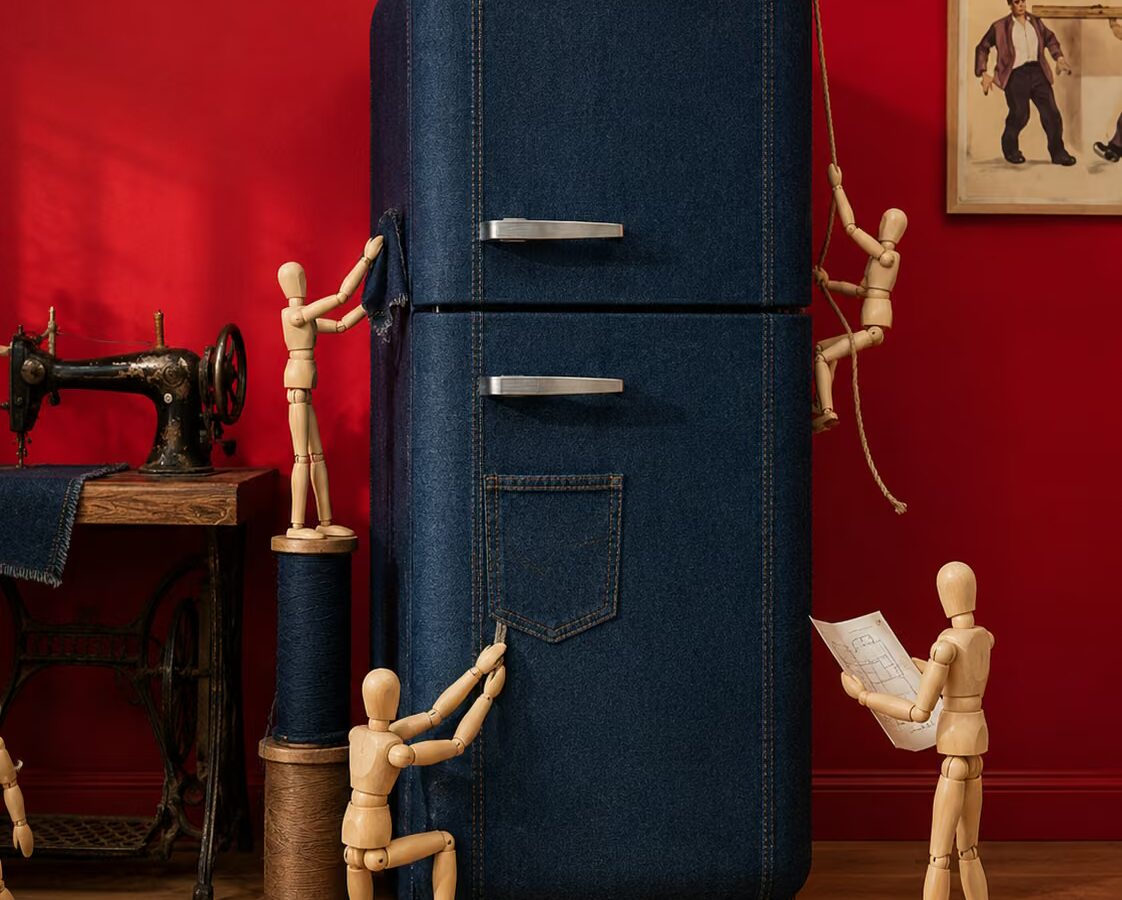
SMEG and Italia Independent bring together two design icons
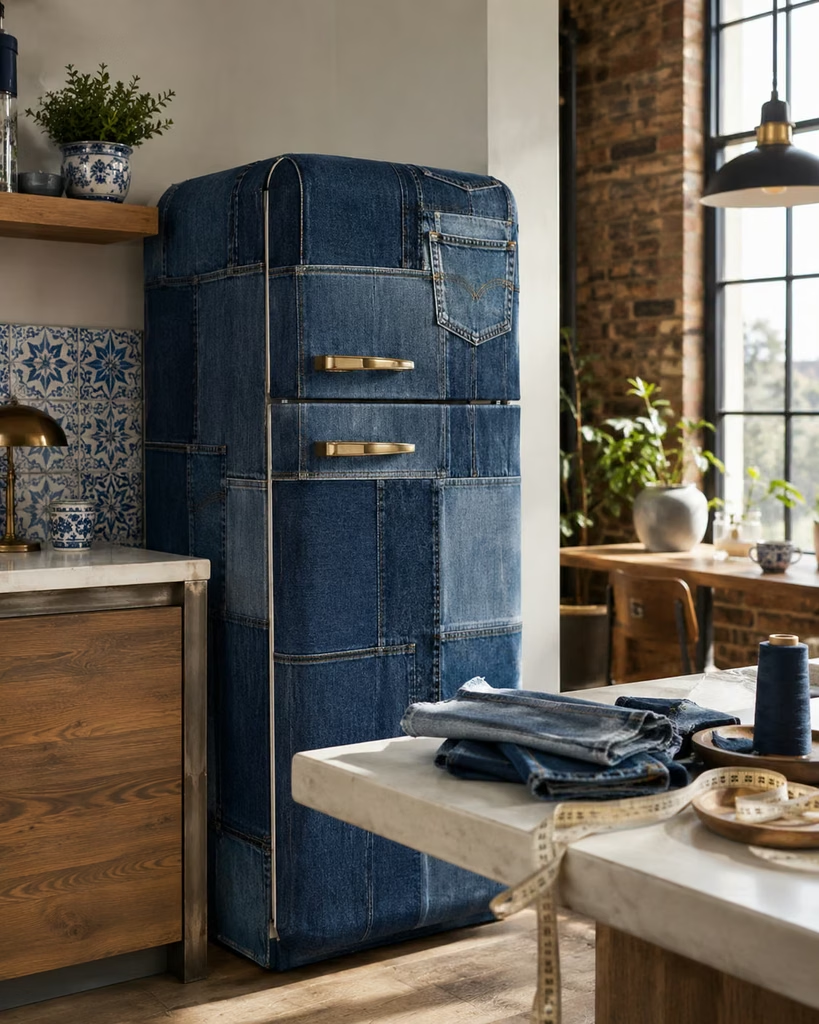
In 2012 , SMEG and Italia Independent conceived a collaboration as unexpected as it was quintessentially Italian: dressing the iconic FAB28 refrigerator entirely in denim . Dubbed the Independent FAB, this limited edition juxtaposes two popular icons—the retro-styled refrigerator and jeans—to transform a household appliance into a true object of Italian design . Produced in only 500 units , the SMEG denim refrigerator perfectly illustrates the increasingly blurred lines between fashion, interior design, and high-end appliances. Its textile covering even benefits from a specific technological treatment to withstand the rigors of daily use in the kitchen.
On one side, there is the SMEG FAB28, with its immediately recognizable rounded lines, chrome handle and aesthetics inspired by 1950s.
On the other hand, there's denim, probably one of the most universal textiles in the history of contemporary fashion. By bringing them together, SMEG and Italia Independent aren't simply aiming to offer a new finish. Their project involves repurposing two objects belonging to the collective imagination to create a third. The result is calledIndependent FAB or FAB28 Denim. This approach is particularly understandable when placed within the context of Italian design, where furniture, automobiles, fashion, and household objects have been interconnected for decades.
On Luxe Daily, this permeability between different creative industries is also at the heart of our analysis of Milan Design Week 2026, which has become a strategic event for luxury brands far beyond just the furniture sector.
The FAB28: a SMEG icon born in 1997
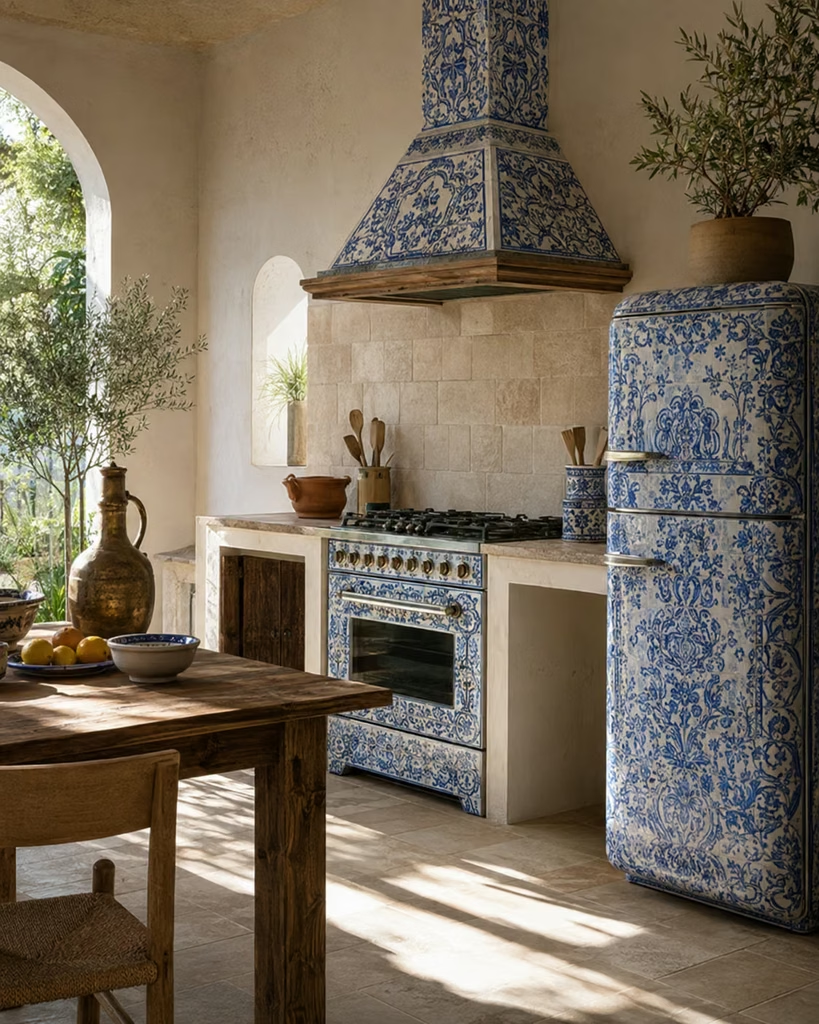
To understand the value of this collaboration, we need to go back to the history of the FAB28. SMEG dates the birth of this line to 1997.The Italian brand wanted to move away from the anonymity oftraditional household appliancesby reinterpreting the 1950s refrigerator in a contemporary version. Its key features were already present:
- soft, rounded shapes ;
- a compact vertical silhouette;
- a very visible handle;
- the use of colour as a decorative element ;
- a deliberately retro aesthetic.
The refrigerator thus ceases to be conceived as an appliance to be hidden away in a kitchen. It becomes a decorative element in its own right. Nearly thirty years later, SMEG is still marketing the FAB28 family , proof of the longevity of this aesthetic vocabulary. This ability of an object to transcend eras and become a true signature echoes the history of other iconic pieces of luxury design .
Why dress up a refrigerator in denim?
The collaboration may seem unexpected. Yet it's perfectly consistent with the world of both brands. Jeans share several characteristics with the FAB28: they're popular, instantly recognizable, and strongly associated with a particular era, while also being timeless enough to be constantly reinterpreted. Italia Independent brings its fashion and lifestyle perspective to the table.
Denim covers the refrigerator's rounded shapes, radically altering our perception of the appliance. A traditionally rigid and cold surface suddenly takes on a textile, tactile, and almost garment-like dimension .
The vocabulary of fashion is thus making its way into the kitchen. SMEG describes this collaboration as the meeting of two icons of the past, destined to produce a new "style icon." Behind the marketing slogan lies a genuine design logic: starting with familiar forms and adapting them for a new use.
A refrigerator entirely covered in denim
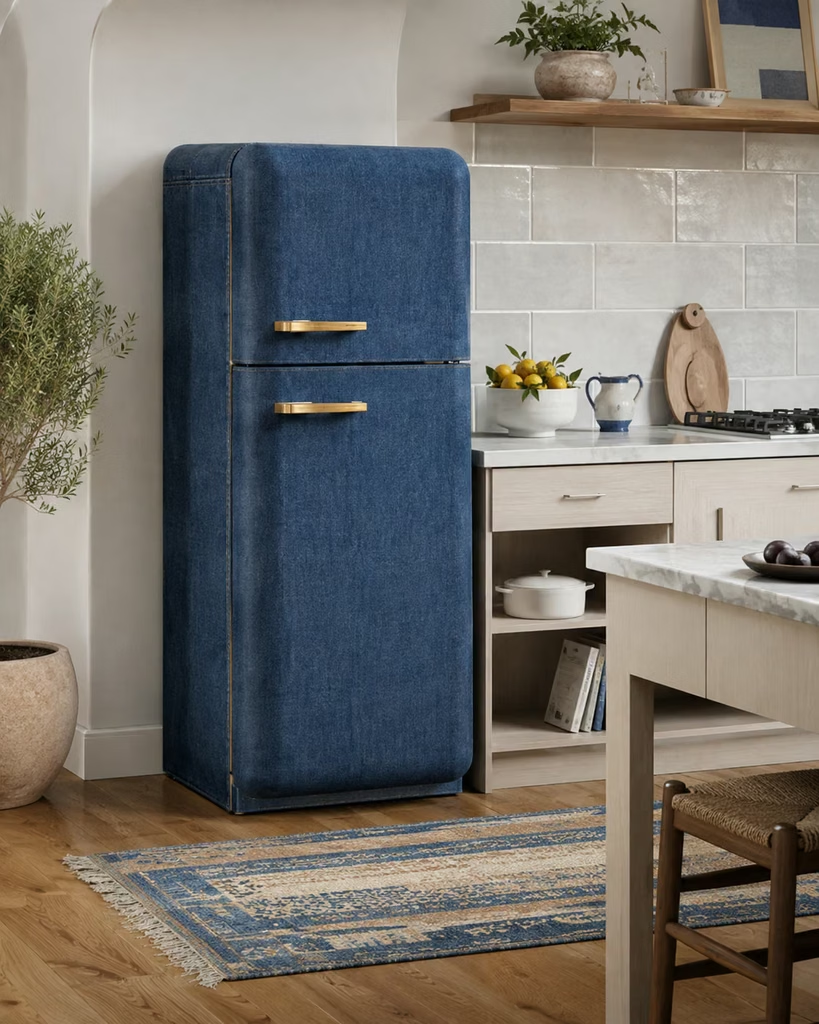
The unique feature of the Independent FAB isn't just a simple print mimicking the look of jeans. The refrigerator is actually covered in denim.
The fabric hugs the rounded contours of the FAB28, giving it the appearance of an almost tailor-made garment. The contrast is striking: the FAB28 belongs to the realm of industrial appliances, while the denim immediately evokes clothing, fashion, and garments. This collaboration thus becomes an early example of what we would now call cross-disciplinary design, with a product situated at the intersection of several creative worlds. In 2012, this approach was still unusual enough to transform a simple refrigerator into a collector's item.
The PLASMA treatment makes the denim compatible with cooking
Covering a kitchen appliance with fabric obviously raises a very practical question: how to prevent stains? A kitchen exposes surfaces daily to splashes of water, grease, milk, or juice. The denim of the SMEG x Italia Independent FAB28 therefore receives a special treatment called PLASMA. SMEG presents this process as a cold, vacuum-assisted nanotechnology designed to protect the textile surface.
The treatment helps to strengthen its resistance to:
- water splashes ;
- oil splashes ;
- traces of milk ;
- fruit juice and other household liquids.
Technology is therefore not a secondary detail of the project. It is precisely what allows an aesthetic idea to be transformed into an object intended for genuine domestic use.
The collaboration is therefore based on a balance between creativity, functionality and innovation in materials.
Only 500 FAB28 Denim refrigerators
The SMEG FAB28 Denim was never intended as a new finish meant to become a permanent fixture in the brand's catalog. It is a limited edition of only 500 units. This extremely small production run immediately sets the appliance apart from the traditional refrigerator. The Independent FAB becomes simultaneously a functional appliance, a design piece, and a potential collector's item.
The phenomenon is particularly interesting in retrospect. Today, collaborations between fashion brands, car manufacturers, furniture designers, and electronics manufacturers have become relatively common. In 2012, the partnership between a home appliance specialist and a fashion brand on such a radical collection was far less frequent.
SMEG would continue this strategy of creative collaborations in the following years, notably with Fiat and then Dolce & Gabbana.
A world first during the Salone del Mobile 2012
TheIndependent FAB was unveiled in Milan in 2012, during the major international design week. SMEG's official archives indicate that the refrigerator was scheduled to have its world premiere during the Salone del Mobile in Milan.
Specialist publications of the time also associated the model with EuroCucina 2012, the event dedicated to the world of cuisine organized within the Salone ecosystem.
A clarification is therefore necessary regarding earlier versions of this article: it is more accurate to refer to a presentation at the Salone del Mobile / Milan Design Week 2012, in conjunction with EuroCucina, rather than simply stating that its launch took place at the EuroCucina trade fair. This Milanese presentation is consistent with the product's philosophy: the Independent FAB aimed not just to be seen as a new refrigerator, but as a demonstration of creative Made in Italy.
SMEG, from appliance manufacturer to design brand
SMEG's history also helps to explain why such a collaboration was possible. Founded in Italy in 1948, the company gradually developed a very strong relationship with architecture and design.
Throughout her history, she has worked with, among others, Guido Canali, Mario Bellini, Renzo Piano and Marc Newson.
The FAB28 then became one of the products that most strongly contributed to associating the SMEG name with a specific aesthetic universe. The appliance was no longer evaluated solely on its storage capacity, energy consumption, or technical performance: its visual presence became a component of the interior design.
This design culture also explains SMEG's subsequent collaborations with brands from other creative industries.
SMEG and Italia Independent, a collaboration continued with the SMEG500
The collaboration between the two companies doesn't end with the denim refrigerator. In 2013, SMEG and Italia Independent partnered with Fiat to create the SMEG500, a minibar integrated into the front of a real Fiat 500. Once again, the idea is to bring two icons of Italian design into dialogue by repurposing their primary function.
The FAB28 Denim thus appears as an important step in a broader strategy: using collaboration to transform a household appliance into a cultural object.
To understand why this approach remains so powerful today, our dossier on the renewal of Italian luxury analyzes precisely this ability to create a dialogue between heritage, innovation and brand image.
Denim: Between Fashion and Interior Design
With this collaboration, jeans temporarily leave the wardrobe and enter the home. This move seems almost natural today, as the boundaries between fashion, decoration, and lifestyle have become increasingly blurred.
Luxury brands develop furniture, architects collaborate with fashion brands, and household items are regularly offered in limited series.
The FAB28 Denim already anticipated this logic. Its interest therefore lies not only in its surprising appearance, but in the way it questions the function of a household appliance.
Does a refrigerator only need to be practical?
SMEG has long answered in the negative: it can also contribute to the aesthetic identity of a room.
Can you still buy the SMEG refrigerator in denim?
A distinction must be made between the historical FAB28 and the FAB28 Denim produced in 2012.SMEG still markets many contemporary variants of its retro FAB28 refrigerator in 2026, with different colours and decorated editions.
However, theIndependent FAB in denim belonged to a limited series of 500 units. Therefore, it should not be presented as a model currently available in SMEG's regular catalog.
When a unit appears today, it is more often found on the secondary market or as a collector's item than as a traditional new appliance. This rarity naturally contributes to maintaining its status as a unique object in the brand's history.
Why does FAB28 Denim remain an interesting creation in 2026?
More than fourteen years after its launch, the SMEG denim refrigerator retains a striking modernity. Not because every kitchen would benefit from a denim-clad refrigerator, but because the project anticipated several trends that are now central to the world of luxury and design:
- collaborations between creative industries ;
- limited editions ;
- the hybridization between fashion and decoration;
- the transformation of functional products into desirable objects;
- the reinterpretation of brand icons ;
- the growing importance of materials in product storytelling.
The project also tells a story that is very Italian: the ability to consider that an everyday object can be simultaneously practical, expressive and cultural.
Luxe Daily's opinion
The Independent FAB is exactly the kind of collaboration that could have easily become a mere gimmick. A refrigerator covered in denim has, on paper, all the ingredients of an object designed solely to attract attention.
However, the proposal works precisely because SMEG and Italia Independent take their idea to the extreme.
Denim is not simply printed on the bodywork: it constitutes a true textile coating, and the use of PLASMA treatment attempts to meet the concrete constraints of a kitchen.
The object thus retains a functional dimension while embracing its spectacular character.
The limited production of 500 pieces completes this transformation: the FAB28 is no longer just a household appliance, but a collector's design piece.
And that's probably why this refrigerator, conceived in 2012, is still worth looking at today.
Official sources
- SMEG France – Company history : official chronology of the brand, birth of the FAB28 in 1997 and collaboration with Italia Independent in 2012.
- SMEG France – Made in Italy according to SMEG : presentation of collaborations and confirmation of the first refrigerator entirely covered in denim.
- SMEG France – FAB28 Refrigerator 50s : current official range allowing the historic Denim edition to be placed in continuity with the FAB28 model.
Additional sources
- SMEG – Independent FAB / Denim Fridge : official archives dedicated to the limited series of 500 copies, the PLASMA treatment and its presentation in Milan.
- SMEG – A History of Collaboration : official retrospective confirming the year 2012 and the print run of 500 copies.


