Transforming an iconic accessory into a fragrance is more than just a stylistic exercise. With Cuir Saddle, launched in early 2026 and part of Dior's Collection Privée, the House orchestrates a bridge between two historic luxury domains: leather goods and perfumery. The challenge goes beyond mere novelty. It's about converting the immediate recognition of an it-bag into emotional capital, then into an olfactory experience, all while reinforcing the coherence of the brand universe.
At the helm, Francis Kurkdjian has created a unisex eau de parfum inspired by the Saddle bag, accompanied by a limited-edition case with leather-like details. This triptych of fragrance, storytelling, and collector's item encapsulates a contemporary strategy: extending the brand equity of an icon by making it wearable in a new way, no longer on the arm but on the skin, and using scarcity as a driver of premiumization.
Dior and the art of converting its icons into perfume language
In the world of luxury, an icon is a mental shortcut. A shape, a material, a name—these are enough to trigger a memory. Dior has long mastered this mechanism, articulating couture, accessories, and beauty around a single promise: a certain idea of Parisian elegance, structured by precise codes. When the House chooses to dedicate a fragrance to a bag, it doesn't simply "decorate" a bottle with a symbol; it seeks to make tangible what the object already conveys.
Perfume possesses a strategic advantage: it brings the imagination close to the body, while allowing for varying levels of price and accessibility. For a group like LVMH, of which Dior is a cornerstone, perfumery is also a driver of volume and customer acquisition. The Collection Privée, however, plays a different tune: less about accessibility than credibility, less about best-sellers than prestige. By including Cuir Saddle in this collection, Dior signals a gesture of heritage and collecting rather than an opportunistic move.
The Saddle, a signature object: from silhouette to symbol
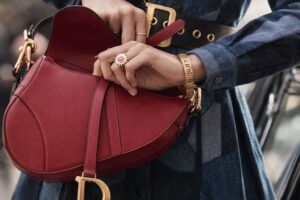
An iconic bag is not merely a high-performing product; it's a silhouette that has become a symbol. The Saddle bag established itself through its recognizable lines, its curve evoking the equestrian world, and its ability to transcend cycles, from reissues and variations to moments of collective desire. In fashion culture, certain objects transcend their function to become "characters": they embody an era, an attitude, a stylistic vocabulary.
This status is precious because it creates a shared language between the House and its public. The buyer is not simply purchasing leather, stitching, and a shoulder strap; they are buying a symbolic sense of belonging. By dedicating a fragrance to this object, Dior transposes this language of the street, the catwalks, and the archives into a more intimate realm: that of skin, of closeness, of personal signature.
From leather goods to juice: translating leather into notes
Saying “leather” in perfumery isn’t a literal term. Leather in fragrance is an olfactory family, constructed through accords, impressions, and raw materials. Historically, the leather accord evokes, in turn, saddlery, suede, gloves, sometimes smoke, patina, or a hint of animalic notes. It’s not about reproducing the smell of a leather workshop, but about stylizing a sensation: that of a dense, sensual, reassuring, subtly shaded material.
The transition from bag to fragrance thus involves capturing attributes perceived as "saddle-like": a tension between structure and curve, between sophistication and casualness, between precious object and everyday gesture. A fragrance inspired by a bag might seek to translate the texture, the warmth of leather, the softness of nubuck, the gleam of a buckle, the crispness of a seam. In this logic, the notes become symbolic equivalents: woods for the structure, musks for the feel, resins for depth, powdery nuances for the hand caressing the material.
Leather as a sensation: patina, softness, precision
Contemporary leather combinations often embrace modernity by avoiding harshness. They favor a suede-like feel, more velvety, sometimes illuminated by amber or iridescent facets. This approach aligns with current luxury trends, which seek tactile appeal and durability, elegance without aggression. For a project like Cuir Saddle, the implicit objective is to convey quality, as one sees the quality of consistent stitching or a meticulously finished edge.
The parallel with crafts is striking: the perfumer composes with materials just as the saddler-leatherworker assembles his pieces. One balances base, heart, and top notes; the other balances panels, reinforcements, and stitching. In both cases, excellence lies in the fit: nothing should be out of place, everything must last.
Francis Kurkdjian, or precision in the service of a unisex fragrance
Entrusting Cuir Saddle to Francis Kurkdjian makes perfect sense. The perfumer's name carries a dual legitimacy: a mastery of classic composition and an ability to create contemporary, accessible yet nuanced signatures. Within the Dior ecosystem, olfactory direction must reconcile heritage and the present day, immediate desirability and lasting power. The mention of a unisex eau de parfum is consistent with this same logic.
“Mixed” doesn’t mean neutralized; it indicates a composition designed to work on a variety of skin tones and styles, freeing itself from overly gendered conventions. Leather lends itself naturally to this approach, as it can be enveloping and powdery, woody and smoky, or ambery and sensual. The desired result is a scent with presence, a fragrance that settles like fine leather: it warms, settles, develops a patina, and ultimately feels uniquely its own.
Why eau de parfum reinforces the idea of matter
The choice of the "eau de parfum" format suggests a higher density than that of an eau de toilette, thus conveying an impression of substance, longevity, and controlled sillage. For a fragrance centered around leather, this concentration is fitting: it suggests substance, depth, and persistence. Like a bag one cherishes, a perfume associated with an "it" bag should remain, not overpower, but accompany it with unwavering consistency.
Dior's Private Collection: a laboratory of style and credibility
Including Cuir Saddle in the Private Collection is no small matter. These so-called “haute parfumerie” collections function like a gallery: they allow the House to express more sophisticated themes, materials, and artistic choices, with increased attention paid to formulas, raw materials, bottles, and presentation. They appeal to existing customers, but also to perfume enthusiasts who judge a House on its ability to create distinctive compositions.
For Dior, this space is a tool for increasing desirability. It repositions the fragrance not as a derivative product, but as a noble extension of the Dior style. By placing a project inspired by a bag within it, the House creates a horizontal link between categories: leather goods are no longer just a business segment; they become a legitimate source of inspiration, on par with a garden, a couture fabric, or a legendary address.
The limited-edition case: leather goods as proof through objects
In the world of luxury, proof counts as much as the narrative. The idea of a collector's case with leather-like details serves precisely to embody the link between bag and perfume. The bottle, the cap, the casing, the finishes—everything related to design and assembly—becomes a canvas for expression. References to saddlery, stitching, grain, and edges act as clues: they confirm that the perfume borrows not just a name, but a culture of gesture.
A well-designed limited edition doesn't just create a sense of rarity. It adds perceived value through its quality of execution, precision of detail, and the feeling of owning a unique piece. In a world where collecting is as much as consumption, the bottle itself becomes a compelling reason to buy, even for customers who already own several fragrances. It's also an object to be displayed, kept, and showcased, extending the experience beyond the first spray.
Brand equity and range extension: the it-bag as an olfactory asset
The concept of brand equity refers to brand capital, that is, the added value a name brings to a product, beyond its technical characteristics. An iconic bag is one of the most powerful assets for fueling this equation: it combines desire, visibility, status, and a story already told by the media, campaigns, and the street. Dior employs a principle ofbrand extension : transferring an established meaning from one category to another, while minimizing the risk of misunderstanding.
This mechanism works when the extension remains consistent with the DNA. Leather, as a noble material and a symbol of craftsmanship, offers an immediate connection between fashion and fragrance. The name “Cuir Saddle” evokes both the material and the icon. It promises a feeling rather than a simple homage. And it allows Dior to tell a story that is understandable in seconds, which has become crucial in an attention economy dominated by image and short narratives.
The benefit is twofold. On the fragrance side, theiconic leather goods serve as an entry point and differentiate the offering in a saturated market. On the accessories side, the fragrance reinforces the bag's mystique, embedding it in a multi-sensory experience. One no longer simply carries a Saddle bag; one can also "wear" its aura, even without owning it.
Scarcity as a tool for premiumization, without losing timelessness
Contemporary luxury grapples with a paradox: it must remain desirable to the widest possible audience while remaining inherently rare.Limited editions are one of the most effective tools for resolving this tension. They create a sense of opportunity, accelerate the decision-making process, stimulate conversation, and fuel the collector's market. But they are not enough. Scarcity must be credible, meaning it must be supported by visible quality and a compelling story.
In the case of Cuir Saddle, the argument of rarity is combined with that of craftsmanship. The leather-like finishes of the case act as a guarantee, almost like the lining of a bag: a detail discovered upon opening, which changes the overall perception. This logic is part of a broader trend: the return of fine craftsmanship, of materials, of time and effort, in response to standardization and consumer fatigue with the "overdone.".
Premiumization is also a matter of timing. A well-calibrated limited edition doesn't exhaust the icon; it subtly reinvigorates it, like an additional chapter rather than an escalation. Diorpositions itself on the side of exclusivity, thus safeguarding the timelessness of the narrative.
Synergies between perfume and leather goods: a shared grammar of luxury
Perfume and leather goods share more than meets the eye. They are two categories where one buys a sensation as much as an object. Leather speaks to the touch, perfume speaks to the sense of smell, but both construct an identity. Both live over time: a bag develops a patina, a fragrance evolves between its top notes, heart, and base. Both lend themselves to a ritual: choosing, applying, wearing, caring for, and preserving.
Synergy also operates in the spaces and the professions. Boutiques become spaces for cross-discovery, where one can enter for a fragrance and leave with an idea for an accessory, or vice versa. The advisors, beauty experts, and sales teams orchestrate this flow.