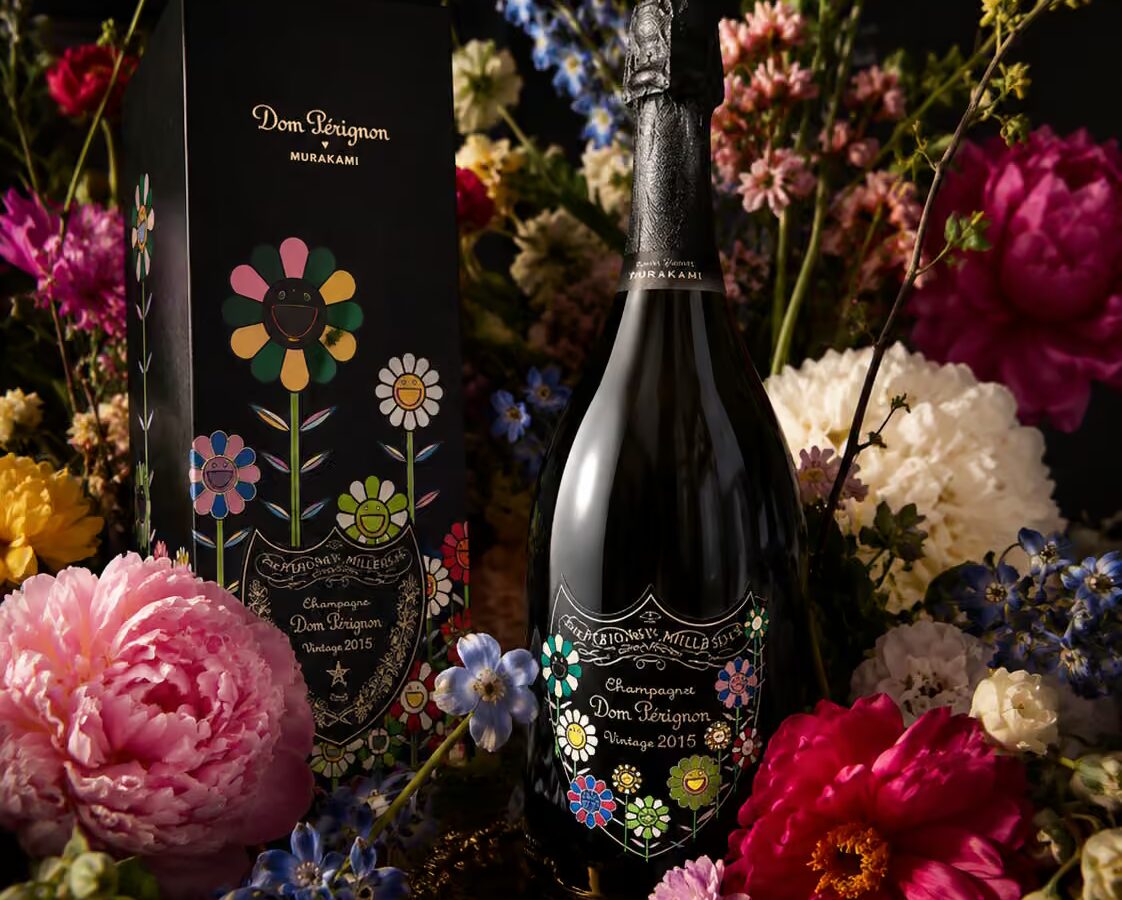
One look at the two bottles is enough to understand why the pairing works. On one side, Dom Pérignon : a vintage champagne, an almost ceremonial bottle, a crest that has become instantly recognizable, and a House whose vocabulary is based on time, blending, and the pursuit of harmony. On the other, Takashi Murakami : smiling flowers, electric colors , kawaii , manga , the Superflat aesthetic , and that rare ability to circulate his work between galleries, museums, fashion, and popular culture.
In 2025, these two worlds will come together around two limited editions: Dom Pérignon Vintage 2015 and Dom Pérignon Rosé Vintage 2010.LVMH officially confirmed the collaboration on October 15, 2025, and presented Murakami as one of the talents participating in the House's new creative chapter, Creation is an eternal journey.
The operation is undeniably visually spectacular. But to reduce it to colorful packaging would be to miss its true significance. Through Murakami, Dom Pérignon explores a fundamental question of contemporary luxury : how to transform an already iconic product into a cultural object without diluting its identity?
Dom Pérignon x Takashi Murakami: what are the two bottles?
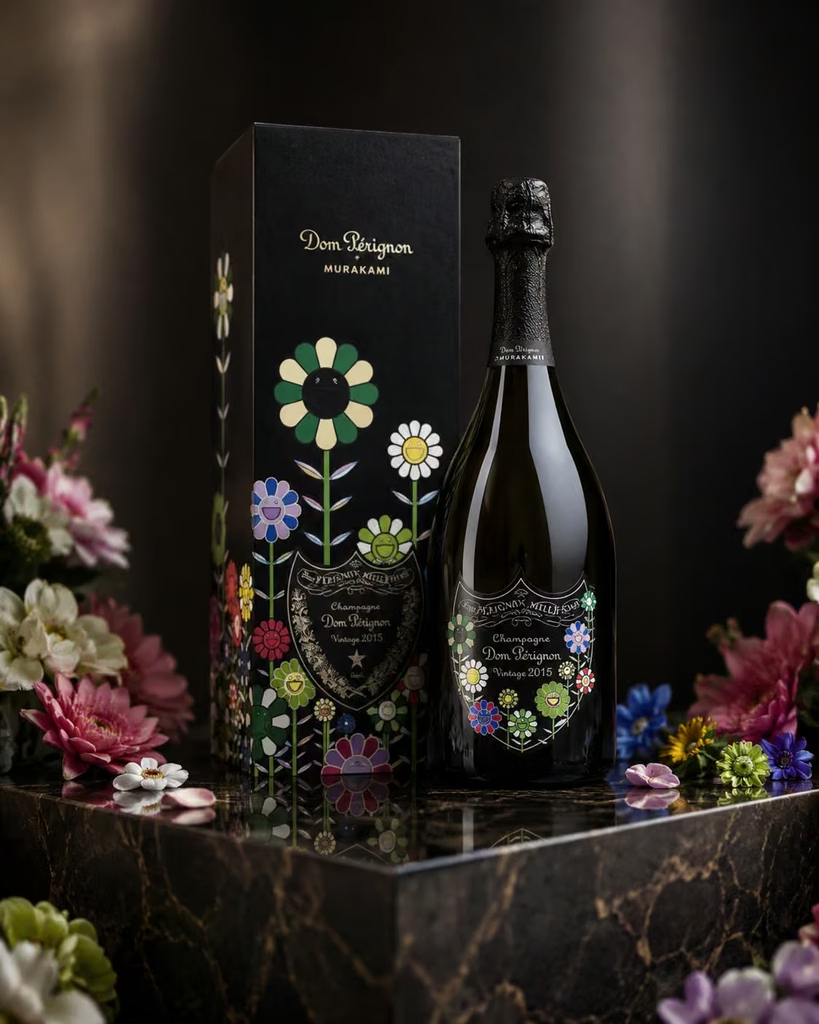
Let's start by definitively clarifying the references.
| Edition | Cuvée | Kind | Murakami's intervention |
|---|---|---|---|
| Dom Pérignon x Takashi Murakami | Vintage 2015 | Vintage white champagne | Bottle and box reinterpreted through the floral universe of Murakami |
| Dom Pérignon x Takashi Murakami | Rosé Vintage 2010 | Vintage rosé champagne | A unique design blending flowers, colors, and Superflat codes |
These are not two new blends created specifically for the artist. The intervention focuses on the visual identity of the limited editions, while the wines themselves remain those of the vintages chosen by Dom Pérignon. The official LVMH press release explicitly presents Murakami as the designer of these two editions. This distinction is significant.
In a successful luxury collaboration, the artist doesn't need to erase the product to impose their vision. Here, the wine retains its signature, while the container becomes a new territory for expression. It is precisely this coexistence that gives the project its coherence.
An immediately recognizable contrast
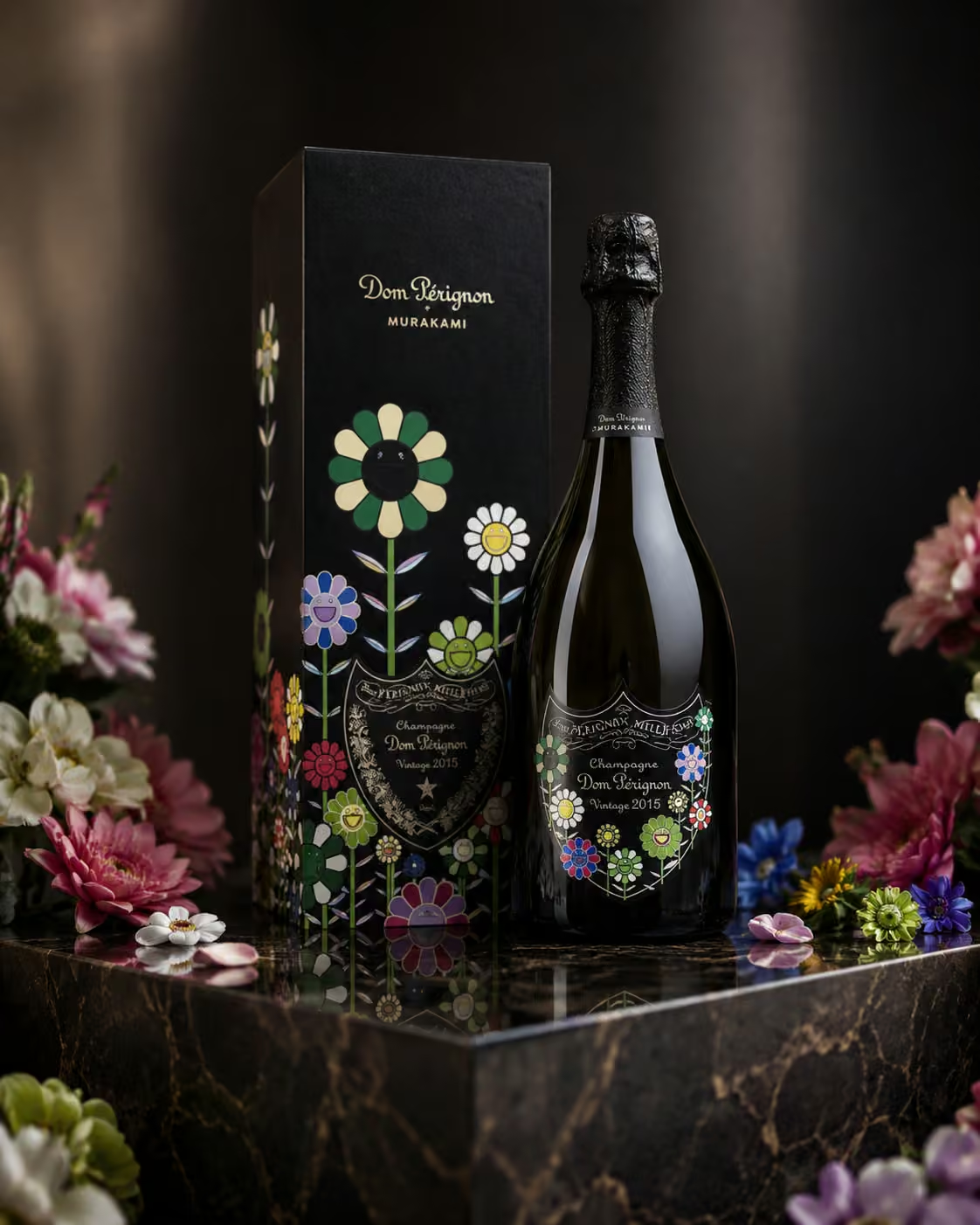
Dom Pérignon traditionally possesses a dark, minimalist, and almost nocturnal aesthetic. Takashi Murakami works in precisely the opposite direction. His smiling, multicolored flowers appear on the bottles and cases like an unexpected bloom. LVMH describes kawaii motifs from its Superflat aesthetic standing out against the dark surfaces of Dom Pérignon. The contrast is radical, but it doesn't destroy the House's codes. It makes them more visible. The black appears deeper against Murakami's colors. The historic crest becomes the center of a floral composition. The bottle remains instantly recognizable as a Dom Pérignon while simultaneously becoming instantly recognizable as a Murakami.
This is probably one of the reasons why this association seems so obvious once it is made: the two identities do not seek to merge. They create tension between them.
Who is Takashi Murakami and why does Superflat speak so well to luxury?
Born in Tokyo in 1962, Takashi Murakami is today oneof the leading figures in contemporary Japanese art. Holding a doctorate in traditional Nihonga, he combines contemporary techniques, Japanese historical references, manga, anime, and kawaii culture. His gallery, Perrotin, notes that in 2001 his aesthetic theory of Superflat, conceived in particular to blur the lines between popular culture and "high art."
This is where Murakami becomes particularly interesting for the luxury sector. His work precisely challenges categories. A painting can become a sculpture. A gallery piece can become a handbag. A motif from popular culture can be integrated into an extremely exclusive environment without losing its visual power. Luxury has long operated in this way: it transforms everyday functions—dressing, traveling, drinking, dining—into cultural and emotional experiences. Murakami has mastered this transition from one world to another for over twenty years.
Luxe Daily recently analyzed this through his return to Louis Vuitton during Art Basel Paris.
From Louis Vuitton to Dom Pérignon: Murakami knows the codes of luxury perfectly
The collaboration with Dom Pérignon is therefore not uncharted territory. Takashi Murakami has a long history with the luxury industry, one of the most famous chapters of which began with Louis Vuitton in 2003, under the artistic direction of Marc Jacobs. LVMH notes that this initial collaboration profoundly influenced the visual culture of the early 21st century before being reinterpreted in 2025.
This precedent is important for understanding Dom Pérignon. Murakami doesn't necessarily treat luxury products as mere advertising tools. He seeks to integrate the House's symbols into his own vocabulary. At Louis Vuitton, the Monogram became an artistic medium.
At Dom Pérignon, the coat of arms, the bottle, and the case become the space for dialogue. This type of collaboration explains why the boundaries between contemporary art, fashion, design, and gastronomy are becoming increasingly blurred today.
Dom Pérignon Vintage 2015: an intense vintage even before Murakami
The first wine chosen for this edition is the Dom Pérignon Vintage 2015.And this choice deserves attention to both the wine itself and the bottle. Dom Pérignon produces only vintage champagnes. LVMH explains that each Vintage requires at least eight years of aging and that the blending process is the foundational element of the House's signature style.
The 2015 vintage comes from a particularly contrasting year. During the Dom Pérignon Revelations held in Barcelona in July 2024, the House described it as intense and textured, with a dense substance, a subtle bitterness that brings tension and a long vibration on the palate.
We are quite far removed from the profile attributed to the 2008 Vintage in the previous article. For the reader specifically searching for " Dom Pérignon Murakami 2015 ," it is therefore essential to find a description that corresponds to the actual wine contained in the bottle. The dialogue with Murakami becomes all the more interesting as the wine and the design operate on almost opposing registers: density and depth in the glass, chromatic exuberance on the outside.
A 2015 vintage already accustomed to dialogue with art
Another particularly revealing detail: the 2015 Vintage wasn't new to contemporary art. On October 31, 2024 , LVMH presented a special Dom Pérignon Vintage 2015 edition created with the heirs of Jean-Michel Basquiat , based on his 1983 work , In Italian
In the space of a year, the same vintage has thus become the canvas for two radically different artistic languages: Basquiat on one side, Murakami on the other. This observation speaks volumes about Dom Pérignon's strategy: the champagne doesn't change its identity with each collaboration; it's the way it's perceived that changes. The bottle then becomes almost comparable to a painting published in multiple interpretations.
Dom Pérignon Rosé Vintage 2010: the second face of the collaboration
Compared to the 2015 Vintage, the Dom Pérignon Rosé Vintage 2010 offers an even rarer expression. At Dom Pérignon, a Rosé requires a particularly long aging process. The official presentation of the House at LVMH mentions twelve years or more for the production of a Rosé, compared to eight years or more for a classic Vintage.
The 2010 vintage also boasts genuine gastronomic merit. In its 2026 guide, Gault&Millau awarded it 94/100 and described it as a highly concentrated champagne, blending notes of citrus, red fruit, spices, dried fruit, and a creamy texture. The guide even suggests pairing it with duck breast with black olives. This is precisely where the collaboration reconnects with gastronomy. The presentation box is admirable. The bottle is worthy of aging.
But Dom Pérignon's ultimate destination remains the glass. And perhaps the best scenario for this type of edition is not to choose between a collector's item and a gastronomic wine, but to accept that it is both at once.
Collector champagne is no longer just about the rarity of the vintage
Champagne houses have long built their desirability around three main concepts: terroir, vintage, and aging . These fundamentals remain essential, of course. But contemporary luxury adds another dimension: the cultural power of the object. A case designed by an artist immediately transforms the perception of the bottle. It gives it an existence even before it's opened, and potentially long after. This logic goes beyond Dom Pérignon .
Moët & Chandon took it even further with Rimowa and its spectacular Legacy Case, a champagne trunk produced in a limited edition of only three. Moët & Chandon x Rimowa : when champagne becomes a travel accessory. In both cases, champagne transcends its primary function. It becomes design, an archive, a gift, a conversation starter, and a heritage object.
Is a limited edition necessarily an investment?
This is a point that needs to be clarified. The limited edition nature of the bottle and the presence of Takashi Murakami's signature can naturally increase its appeal to collectors.
This does not mean that a capital gain is guaranteed. The official press release confirms the limited edition status , but does not disclose the global number of copies produced or any promise of financial appreciation.
To speak of "appreciation potential" as an intrinsic characteristic of the bottle would therefore be an exaggeration. Its future value will depend in particular on availability, the condition of the case, storage conditions, demand for the vintage, and the market's sustained interest in Murakami. For a connoisseur, the primary value lies elsewhere: possessing both a great vintage champagne and the tangible evidence of a specific artistic encounter.
Why do artistic collaborations work so well in the luxury sector?
The Murakami x Dom Pérignon collaboration addresses several fundamental mechanisms of desirability. The first is immediate recognition. A Murakami flower hardly needs a signature. Neither does the Dom Pérignon bottle. The second is the complementarity of the target audiences.
The art collector can discover a vintage. Thechampagne enthusiast can enter the artist's world. And the luxury consumer, accustomed to fashion collaborations, will find a mechanism they already understand perfectly. Finally, the project creates a narrative that goes beyond a simple variation in packaging.
This is precisely what distinguishes lasting collaborations from opportunistic co-branding operations. Luxe Daily has dedicated a comprehensive analysis to this dynamic of collaboration in the luxury sector.
Dom Pérignon has maintained this dialogue with artists for several decades
Murakami is not an isolated case. LVMH points out that Dom Pérignon has already worked or collaborated with creators and artists such as Karl Lagerfeld, Andy Warhol, Jeff Koons, Lenny Kravitz , and Jean-Michel Basquiat. This continuity profoundly alters the interpretation of the 2025 collaboration.
This is no longer a champagne brand that "makes art" to attract attention. Dialogue with the arts has become a recurring theme for the House. Murakami's involvement is like a new chapter in an already long history. And perhaps this is where Dom Pérignon succeeds better than many other brands: the collaboration never diminishes the enduring nature of the product. The artist comes and goes. The vintage remains.
By 2026, the desirability of prestige wines will once again become a strategic issue
The collaboration also takes on particular significance when considered within the context of the Champagne market. After several challenging years for wines and spirits, LVMH reported in July 2026 that this business had returned to organic growth of 5% in the first half of 2026, with current operating income up 11%. The group specifically noted encouraging signs in Champagne and for prestige cuvées.
Context matters. In a market where consumers are becoming more selective, mere brand recognition is no longer necessarily enough. Brands must continue to cultivate desire while preserving their legitimacy. Experiences, limited editions, and artistic collaborations then become particularly effective tools.
Veuve Clicquot, for example, explores this same notion of desirability by transforming champagne into an experience of the art of living and gastronomy. Dom Pérignon chooses a different path: that ofcontemporary art as an amplification of the vintage.
Murakami doesn't just decorate the bottle: he materializes time
Perhaps the most interesting detail of this collaboration lies in the artist's own words. To explain his work with Dom Pérignon, Murakami evokes the idea of a journey through time and his desire to create something that could still have meaning in one or two hundred years.
This obsession is surprisingly similar to that of champagne. Wine spends years in obscurity before being revealed. A work of art also transcends generations, changing in perspective, context, and sometimes meaning.
The point of convergence between Dom Pérignon and Murakami is therefore not color. It is time. The time it takes for a vintage to become Dom Pérignon. The time it takes for an image to become iconic. And the time that will eventually transform a 2025 bottle into a cultural testament to an era.
Dom Pérignon x Murakami: much more than a pretty gift set
The smiling flowers will naturally inspire the first photographs. They are spectacular, instantly shareable, and perfectly suited to a year-end edition or a special gift. But that's probably not what makes the collaboration most interesting.
Dom Pérignon x Takashi Murakami works because each brand remains perfectly recognizable. The House doesn't become a pop brand.
Murakami doesn't become a conventional packaging designer. A tension exists between the two: that of a champagne crafted over time versus a color-saturated imagination, of French heritage versus the Japanese avant-garde, of a wine destined to disappear in the glass versus a case that some will want to keep. Contemporary luxury is often most compelling when it succeeds in this equation: creating something new without having to erase what came before.
With the limited editions Vintage 2015 and Rosé Vintage 2010, Dom Pérignon and Takashi Murakami are not simply creating two desirable bottles. They are demonstrating how a great wine can become, for the duration of a limited edition, an object of culture.
Frequently Asked Questions about Dom Pérignon x Takashi Murakami
Which Dom Pérignon was created with Takashi Murakami?
The collaboration involves two limited editions: Dom Pérignon Vintage 2015 and Dom Pérignon Rosé Vintage 2010.LVMH officially presented them as part of the collaboration with Murakami in October 2025.
Does Dom Pérignon Murakami exist in a 2008 Vintage version?
The 2008 Vintage is not one of the two vintages in the limited Murakami edition announced for 2025.The white reference is the 2015 Vintage.
Is Rosé Murakami a Dom Pérignon 2006?
No. The Murakami edition is based on Dom Pérignon Rosé Vintage 2010.
Did Takashi Murakami create champagne?
No. His involvement concerns the design of the limited editions. The wines are the Dom Pérignon Vintage 2015 and Rosé Vintage 2010 cuvées.
Why do we talk about the Superflat style?
Superflat popular culture and fine arts into dialogue, with a strong emphasis on two-dimensionality.
Will Dom Pérignon Murakami bottles increase in value?
No future appreciation is guaranteed. Rarity, condition, vintage, demand, and the artist's market can influence a bottle's value, but a limited edition does not automatically constitute an investment.
Official French sources
LVMH – Dom Pérignon, vintage champagnes: history, blending, maturation, and the House's philosophy. See the official French presentation of Dom Pérignon at LVMH.
LVMH – Revelations 2024: Official presentation of Dom Pérignon Vintage 2015 and its sensory profile. Consult the official LVMH source on Dom Pérignon Vintage 2015.
Main official source of the collaboration: LVMH, announcement of October 15, 2025 confirming the Dom Pérignon Vintage 2015 and Rosé Vintage 2010 editions designed by Takashi Murakami.
Excessive alcohol consumption is dangerous for your health. Drink in moderation.