

Well-being as a new territory of expression for luxury brands

Long confined to the realms of beauty, perfume , and lifestyle, well-being is now emerging as a creative field in its own right. Customers are no longer simply looking to own an object, but to improve their daily lives, characterized by a hectic pace, constant mobility, mental strain, and performance demands. In this context, luxury finds fertile ground: a promise of balance, calm, and quality, built around a simple yet powerful idea—the "best version" of oneself, not spectacular, but sustainable.
Dior 's decision to launch a high-end sports and wellness line is part of this transformation. It also reveals a cultural shift: attention to the body is no longer limited to aesthetics; it is expressed through practices, rituals, and objects dedicated to mobility, recovery, and relaxation. The vocabulary evolves with the market: "wellness" refers to a holistic approach to health and well-being, while "mindfulness" refers to techniques of attention and breathing aimed at reducing stress and clarifying the mind. " Haute Wellness, " for its part, embraces an ambition of refinement comparable to that of haute couture: the very best in technique , materials , and intention .
What Dior's Haute Wellness line encompasses: gentle exercise, mindfulness, recovery
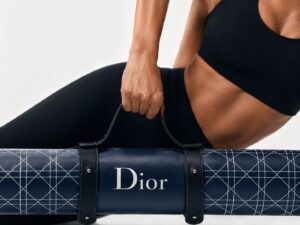
Dior 's new offering is centered around a triptych that has become central to contemporary routines: sport, mindfulness, and sleep. The announcement evokes iconic accessories from "studio" disciplines like yoga and Pilates, including a dedicated mat, as well as strengthening and proprioceptive elements such as weights and a ring. These objects may seem simple, but they are in fact the ones we use most often, in the privacy of a living room, a hotel room, or a practice studio. Their adoption by a House like Dior speaks volumes: luxury is no longer just about going out, socializing, or events; it is now invading private spaces and moments of reconnection with ourselves.
Talking about "sport" here doesn't necessarily mean performance in the athletic sense, but rather regularity, posture, breathing, flexibility, and muscle tone. Yoga and Pilates, in particular, lend themselves perfectly to a premium approach: they place great value on the precision of movement and the quality of the support, from the grip of a mat to the comfort of handling. Mindfulness, on the other hand, introduces an intangible dimension that is difficult to "design" without becoming a mere gimmick; this is where the legitimacy of a House of Art and Detail becomes crucial. Finally, sleep, which has become a societal issue, opens up a field of innovation: we speak of "sleep wellness" or "recovery," a set of practices that aim to improve sleep, recovery, and energy regulation.
Why yoga and Pilates appeal to the luxury sector: an aesthetic of discipline?
Yoga and Pilates are disciplines particularly well-suited to the world of fashion houses. Firstly , because they rely on repetition and precision, two values akin to craftsmanship: progress is made through refinement, much like a workshop perfecting a garment. Secondly, because they are visual, but with a restrained visuality: lines of the body, alignment, purity of form. This simplicity provides an ideal setting for design, provided that function is respected. A yoga mat, for example, cannot simply be beautiful; it must be stable, cushioning, easy to clean, durable, with a surface that ensures grip without irritating the skin.
In the contemporary imagination, the Pilates studio sometimes replaces the social gathering place: it's where people meet, observe each other, and exchange recommendations for coaches, retreats, and addresses. The boundary between sport and sociability shifts. Luxury, which knows how to orchestrate communities and codes of recognition, can find a natural language there. Finally, these disciplines align with a concept that has become essential: preventative health. Pilates is often associated with core strengthening, posture, and back health; yoga with breathing, mobility, and stress management. These are all universal concerns, relatively unaffected by trends, and therefore perfectly "evergreen."
The Dior object: when design must serve function as much as desire
The challenge of a Haute Wellness line lies in striking a balance between desire and functionality. Luxury is expert in symbols, monograms, and signatures; well-being, on the other hand, immediately penalizes any imprecision. A Pilates ring that's too rigid, an unbalanced weight, a slippery mat—and the object betrays its promise. For Dior, the challenge is therefore to translate its codes without betraying the practice. It's a question of proportion, ergonomics, even silence: a good accessory becomes invisible, allowing movement to take center stage.
Materials become a strategic language here. In sports, performance is often associated with technical materials: specific rubbers, calibrated-density foams, non-slip textiles, and sweat-resistant finishes. In luxury, materials also speak of the hand, durability, and feel: leather worked by a leather craftsman, crisp stitching, textures that age beautifully, and expertly crafted metallic details. Success will come from intelligent hybridization: combining the rigor of the technical product with refined execution. This is precisely where the arts and crafts can express themselves, not to add decoration, but to elevate the feel, the stitching, the assembly, and the durability.
There's also the question of space: these accessories live in the home. They must remain visible without cluttering the interior. Luxury has always excelled at objectifying the everyday, transforming a necessity into a decorative piece. Haute Wellness follows this trend: a mat that folds away like a beautiful object, weights that don't resemble medical equipment, a ring whose shape complements the furniture. designisn't an extra; it's a way to make the practice more likely, and therefore more regular.
Mindfulness, or the art of invisible luxury
Mindfulness presents a particular challenge: how to embody an inner practice without reducing it to a mere accessory? In the luxury sector, the most credible answer is often the same: cultivate the setting. Silence, the quality of touch, the beauty of a minimalist object can foster a ritual. A rug that invites you to lie down, a reassuring texture, a craftsmanship that inspires confidence—these are discreet yet structuring elements. Haute Wellness, then, has less to do with the spectacular than with consistency.
This dimension evokes the idea of the "art of living," so dear to the great fashion houses. Dior, historically, is not just a wardrobe; it's a grammar of elegance that extends to fragrance, beauty products, certain accessories, and a particular appreciation for gesture. Applying this grammar to breathing, concentration, and the moments of transition between activities means expanding the brand's territory into what could be called the luxury of attention. In a world saturated with notifications and images, true premium is sometimes what reduces the noise.
Sleep, the new premium obsession: from the hotel room to home

Sleep " cycles, recovery, and lifestyle. This growing importance stems from a simple reality: without recovery, there can be no sustained performance, either physical or mental. The "sleep wellness" market has already seen the emergence of technological solutions, textiles, rituals, and a renewed focus on bedding. When a luxury brand embraces this trend, it introduces another promise: that of sleep as an aesthetic, sensory, and reassuring experience.
Dior's line, explicitly positioned around sleep alongside sport and mindfulness, indicates that well-being is no longer limited to activity but includes rest. And rest is a time when customers want proof of quality: a pleasant feel, no irritation, temperature regulation, a sense of protection. Even without detailing each product, the logic is clear: luxury can offer its expertise in textiles, finishing, and fragrance through rituals, and the creation of a bedroom conceived as a sanctuary. In the hotel industry, luxury hotels have understood this for a long time; at home, the demand is following suit.
A coherent brand strategy: Dior, LVMH and the expansion of their universes
To view this initiative solely as a marketing ploy would be to miss a deeper trend: the Houses are building complete universes. Like certain strategies within large groups such as LVMH, the idea is no longer simply to offer products, but lifestyles. In this context, a high-end sports and wellness line is a logical extension: it engages with Dior beauty, with the concept of skincare, with the attention paid to the figure, but it shifts the focus towards lived experience, rhythm, and daily health.
For Dior, the stakes are also narrative. The House has powerful, instantly recognizable codes and a heritage rooted in the construction of the silhouette. Gentle exercise and mindfulness also speak of posture, alignment, and momentum. It's interesting to see how these notions can resonate, effortlessly, with the couture ideal: correct posture, like a perfect cut, changes self-perception. In a luxury magazine, one might say that Dior is less concerned with "doing sports" than with dressing a moment of intimate discipline, with the same attention to line and support.
The competitive landscape: athleisure, collaborations and signature well-being
Luxury isn't entering uncharted territory. For several years, athleisure has blurred the lines between sportswear and urban wardrobe, while premium studios have transformed workouts into experiences. Luxury brands have explored this territory through capsule collections, collaborations, sneakers, and accessories. What Dior's Haute Wellness collection signals is a maturation: it's no longer just about wearing a sport-inspired look, but about actually practicing, with items that complement the workout.
In this landscape, differentiation isn't solely based on the logo. It hinges on user-friendliness, the ability to convey a vision of well-being, and the associated services. Some brands rely on coaches, retreats, spas, and in-store experiences. Luxury hotels, from Paris to Los Angeles, have contributed to this movement by making wellness a cornerstone of hospitality, on par with gastronomy. Dior, by launching a dedicated line, is positioning itself in a segment where expectations are high and loyalty is possible: if an object becomes part of a routine, it acquires lasting emotional value.
What customers really want: quality, durability, and luxury that feels good
The central question for the consumer isn't "Is it Dior?" but "Does it improve my practice?" In the wellness sector, disappointment is immediate, while satisfaction develops over time. This requires sound industrial choices, testing, and a deep understanding of needs. A mat must remain stable on different surfaces, not crumble, maintain its grip, minimize odors, and withstand frequent use. Weights must be comfortable, secure, and well-balanced. High-end wellness products, if they are to stand the test of time, must meet these criteria without compromise.
Sustainability is also becoming central, beyond mere rhetoric. In the wellness world, there's often a search for a kind of coherence: taking care of oneself and respecting the environment. Materials, repairability, longevity, minimalist packaging, and even manufacturing conditions matter. Leather, textile, and finishing crafts can create objects that are kept, passed down, and develop a patina. But ethics must follow, because the purchase isn't purely impulsive: it's often driven by the idea of investing in a better quality of life.
Finally, there is the most subtle expectation: sensation. Luxury is recognized by what we feel. A seam that doesn't dig in, a reassuring texture, a well-distributed weight, a neutral and clean scent, a zipper that glides perfectly—these are the micro-details that make all the difference. Well-being, paradoxically, is a school of exacting standards: it pushes luxury to become functional again, to prove its value with every use.
How to recognize a high-end wellness accessory: some simple guidelines?
Premium isn't just about price; it's about relevance. For a yoga or Pilates mat, quality is reflected in its stability, density, grip, and ease of maintenance. A good mat feels unobtrusive under the body while still providing secure posture. The surface should feel firm yet protective, without a bouncy, trampoline-like effect that can cause imbalance, or a harshness that discourages. In this category, luxury should avoid excessive embellishment that could hinder use or accelerate wear.


