

Luxury is no longer limited to seating: the era of lived experience
Sleeping in the sky! In contemporary luxury, the object is often just the starting point. What truly distinguishes a brand is how it orchestrates a moment, an emotion, a memory. Air travel is no exception to this logic: beyond the engineering of the seat, the wine list , or the chef's signature, a discreet realm is becoming central to the perception of high-end: the night.
The partnership between Air France and Sofitel fits precisely into this movement, by establishing sleep in flight as a true brand promise.
This shift reflects a simple reality: on a long-haul flight, the Business Class passenger isn't just "consuming" transportation; they're buying recovered time. In a world of tight schedules, frequent travel , and meetings upon landing, value lies not only in space but also in the ability to arrive more rested, more productive, and less jet-lagged. The sleep experience, understood as the set of conditions that allow for quality sleep, thus becomes a premium lever as strategic as seating comfort.
Why does sleep become a battleground in the long-haul Business Class cabin?
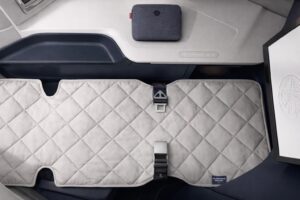
Sleep on board is a difficult promise: the altitude, the pressurized cabin, the drier air, the ambient noise, the light, the movement, and the density of service combine to create an environment naturally hostile to deep rest. Yet, it is precisely because the process is complex that it becomes a distinguishing feature. When an airline manages to reduce friction and establish a credible nighttime routine, it transforms a universal constraint into a competitive advantage.
The long-haul Business Class cabin is particularly affected. It occupies a delicate crossroads: premium enough to demand a high-level experience, yet large enough to require consistency. First Class can afford ultra-personalization; Economy must first and foremost optimize efficiency. Business Class, for its part, must reconcile high standards, global consistency, and profitability. Focusing on sleep is to address the core value proposition of this cabin: arriving better, faster, and more peacefully.
Hospitality x aviation: the logic of an alliance between Air France and Sofitel
What can a hotel bring to an airline ? In the public imagination, the hotel industry possesses expertise that theairline industry has long approached only in fragments: the night as a complete experience. Sofitel, an iconic brand within the Accor group, is associated with the art of living, with bedding designed as a signature, and with a refined comfort where attention to detail is as important as the architecture. By joining forces, Air France and Sofitel are establishing a shared language: that of French hospitality transposed into the world of travel.
Strategically, this type of partnership has an immediate effect: it lends credibility to the promise. Passengers may not know the exact model number of a seat or a reclining mechanism; they instinctively understand what "sleeping like in a hotel" means, especially when the Sofitel name acts as a cultural touchstone. For Air France, the partnership also serves as a narrative bridge between the cabin and the travel ecosystem, from the airport lounge to arrival, leveraging a hospitality brand already established in major capital cities.
Defining the "sleep experience": a system, not an accessory
The sleep experience is more than just a softer pillow. It's a cohesive system designed to facilitate fallingasleep, minimize micro-awakenings , and improve the quality of recovery. It combines tangible elements, such as bedding, with intangible elements, like the service sequence, the lighting ambiance, the timing of announcements, and the way a snack is offered. In the luxury sector, the difference often lies in the continuity: the experience must be seamless from the beginning of the night until waking, without any perceptible inconsistency.
This paradigm shift is significant for the airline industry. Historically, innovationhas focused on the seat, connectivity, catering, and entertainment. Sleep, on the other hand, was sometimes treated as an afterthought: a lie-flat seat, a blanket, and the rest was up to the passenger. However, as cabins become more technologically similar, the emphasis shifts towards the details of execution. The promise of a better-supported sleep experience is becoming a marker of service maturity.
Nighttime rituals: how does service create the feeling of luxury?
In a luxury hotel, the night is carefully orchestrated: the room is prepared, the lighting is adjusted, attention is paid to silence, and staff are discreetly available. Transposing this to a cruise ship means transforming a series of technical gestures into a fluid ritual. Experiential luxury isn't proclaimed; it's felt, often through an invisible choreography. The way the crew prepares the bed, dims the lights, minimizes interruptions, and anticipates the wake-up call is an essential part of the perceived value.
The vocabulary of service is as important as the product itself. Saying " we're preparing your night " doesn't have the same impact as saying " I'm bringing you a blanket ." The promise takes shape when it's embodied by professionals: flight attendants trained in hospitality, product managers who translate hotel standards into airline constraints, designers who focus on usability, and even laundry teams who guarantee consistent textile quality. The goal isn't to add extra steps, but to make the whole experience more seamless, more refined, and more authentic.
Design and materials: bedding, textures and details that matter at 10,000 meters
Sleep where hotel expertise truly shines: choosing pleasant fibers, balancing warmth and breathability, the feel of the fabric, and its durability. Quality cotton, a denser weave, meticulous finishing, and a feel closer to bed linen than a simple blanket: these are the nuances that make all the difference.
Design just about aesthetics. It must address practical constraints: how to cover yourself without exposing yourself when turning over, how to avoid an overly warm "cocoon" effect, how to offer a pillow that provides support without sagging, how to create the feeling of a bed without adding excessive bulk. In the world of luxury, intelligent design is a form of refinement. And when a brand like Sofitel is associated with this, expectations immediately shift to a "hotel" standard: draping, softness, precision.
Sensory experience also extends to the atmosphere. Warmer lighting, reduced contrasts, soothing tones, and perhaps a consistent, but not overdone, scent: the goal is to create a nighttime cue. Here again, the hotel industry has a head start, having long mastered the concept of a discreet signature. On airplanes, subtlety is crucial: too much fragrance or too many effects would become intrusive, and therefore counterproductive to rest.
From standards to operational reality: train, measure, repeat
Mass-produced luxury only exists through intelligent standardization. A partnership like Air France x Sofitel is only valuable if it translates into consistent execution across the entire long-haul network, regardless of flight rotations, crews, or bases. This requires clear service protocols, appropriate training, robust textile logistics, and the ability to monitor quality over time. The promise of a superior sleep experience doesn't forgive inconsistency: an excellent flight followed by an average one creates a dissonance that undermines trust.
Measuring sleep is tricky, as it's a deeply personal and subjective experience. However, indirect indicators can be tracked: satisfaction with nighttime comfort, perception of cabin quietness, bedding evaluation, consistency of waking up, and ability to fall back asleep after an interruption. In a sector where the Net Promoter Score and qualitative feedback guide decision-making, the night becomes a field of observation in its own right. The strength of collaborating with a hotel chain also lies in its methodology: the hotel industry knows how to audit an experience, identify pain points, and refine the details.
Global competition: why is the battle fought at night?
The premium long-haul market is one of the most competitive, dominated by players who have made experience a key strength. Qatar Airways, Emirates, Singapore Airlines, as well as ANA and certain North American offerings, have raised the bar in terms of hard product, service, and passenger attention. In this context, differentiation relies on areas less easily copied than the geometry of a seat. Sleep, because it combines product, service, and ambiance, is more difficult to replicate quickly.
Air France possesses specific strengths: a strong cultural image centered on French elegance, a tradition of gastronomy, and an ability to convey a certain art of living. By partnering with Sofitel, the airline reinforces its distinctly French identity in a very concrete area: the night. Faced with competitors who emphasize ultra-modernity or extravagance, the focus on sleep can become a more emotional signature, centered on refinement, tranquil comfort, and attentiveness to the traveler's rhythm.
From a business perspective, the stakes are clear: preserving the pricing power of Business Class, strengthening the loyalty of frequent flyers, and supporting the preference of companies that choose this option when negotiating their contracts. A successful night's sleep transforms the perception of value. And in the experience economy, the memory of a flight often boils down to a few key moments: the welcome, the meal, and above all, how well one slept.


