FY2025 results interpreted as a language, not as a simple balance sheet
Hermès and the grammar of luxury
Looking at Hermès' FY2025 results as one would read a profit and loss statement would be to miss the point entirely. At the house on the Faubourg Saint-Honoré, performance isn't just economic: it's semantic, in the sense that every decision regarding product, distribution, service, and communication generates meaning before it generates revenue. What FY2025 confirms is a coherent architecture where luxury isn't "created" by adding attributes, but by articulating a complete system: scarcity, verticality, desire, and temporality.
In a sector that often oscillates between commercial acceleration and the pursuit of prestige, Hermès stands out as a structural exception. Not because it is outside the market, but because it treats the market as a consequence. Categories are not territories to be conquered at all costs; they are territories to be inhabited with a professional logic. The result is a rare ability to grow without dissolving, to raise prices without losing relevance, to expand the offering without trivializing the icon.
This "meaningful" reading also sheds light on why the Hermès model is more resilient than more promotional or over-exposed strategies. Where some brands base their desirability on media intensity, Hermès bases it on stability: a promise kept, repeated, and verified through product experience. From this perspective, FY2025 becomes an X-ray: it reveals less of a peak than a framework.
Scarcity: not shortage, but the discipline of availability
Scarcity is often misunderstood, as if it consisted of deliberately "scarce" products. At Hermès, it is more accurately described as a discipline: availability is carefully calibrated to remain compatible with the demands of manufacturing, service, and storytelling. Scarcity is not an isolated artifice; it is the consequence of a mode of production and distribution that rejects the logic of volume as its ultimate goal.
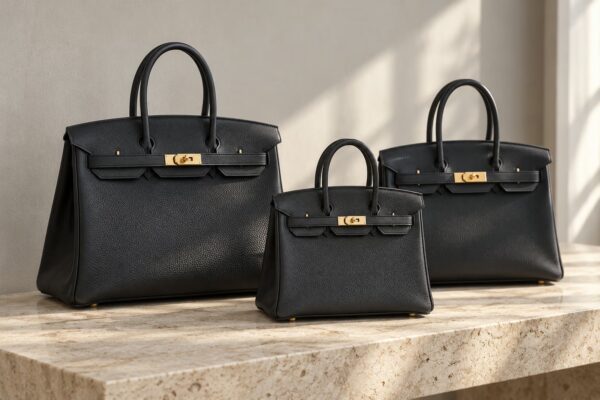
Leather goods are emblematic of this, with bags whose acquisition is tied to a specific timeframe. The Kelly or the Birkin are not merely objects; they are appointments. The anticipation, when it exists, is not a marketing tool overtly displayed as such: it stems from an artisanal rhythm, from the management of leathers, from the training of artisans, from quality control. This temporality transforms the purchase into a narrative experience: the future is part of the value.
FY2025 confirms that this disciplined approach to supply doesn't hinder growth; it sets the conditions for it. In a luxury sector where "desirable" has sometimes been confused with "universally accessible," Hermès reminds us that overly broad accessibility can become a form of erosion. Here, scarcity isn't an aggressive barrier; it's a clear boundary that protects the product's essence.
Verticality: professions as the backbone, not as decoration
Luxury loves to talk about craftsmanship; Hermès organizes it. Vertical integration isn't simply about industrial integration, but about a hierarchy of priorities where the craft dictates the strategy. When the house invests in its workshops, in training leatherworkers, in selecting hides, in silk for its scarves, it doesn't just "talk" about excellence: it manufactures it, literally. And this manufacturing becomes the most solid foundation of its pricing power.
Pricing power, in this context, is not simply the ability to raise prices; it is the ability to make the increase understandable. The customer is not just paying for a brand: they are paying for an invisible structure made up of labor time, actions, quality control, repairability, traceability, and a service that extends the product's lifespan. This understanding distinguishes an "acceptable" price increase from an "incomprehensible" one, a distinction that becomes crucial when the market tightens.
Verticality also acts as an antifragile system against the cyclical nature of fashion. A brand heavily reliant on image, a seasonal "it" bag, or an overexposed logo can accelerate rapidly and then slow down abruptly. Hermès, by relying on its crafts, anchors desirability in continuity. Fashion exists, but it is framed by a culture of enduring objects.
Desire as a consequence of protocol: codes, restraint and precision
Desire is often approached in the luxury world as a mystery, when in fact it also functions as a protocol. Hermès works with this protocol through restraint: clean silhouettes, judicious colors, recognizable yet understated silk patterns, and a controlled discourse. Luxury here is not excess; it is precision. And this precision creates a form of aesthetic confidence: we know that an Hermès object will not seek to seduce in the moment, but to convince through time.
The house's codes play a central role. Leather, saddlery, hardware, silk, box paper, the iconic orange, typography, in-store design: everything acts as a coherent language. This coherence is the opposite of a "noise" strategy where signals are multiplied to capture attention. Here, attention is invited, not solicited.
FY2025, by its very nature, highlights an often overlooked fact: consistency is a source of performance. In an environment where consumers are exposed to thousands of images, a brand that maintains a stable identity provides a point of reference. This point of reference is invaluable because it reduces uncertainty. And in the luxury sector, reducing uncertainty means increasing confidence, and therefore the willingness to invest in a product.
Temporality: selling time, protecting time, lasting over time
A “semantic architecture” of luxury presupposes a particular temporality. Hermès doesn't just sell products; it sells a relationship with time. First, the time of manufacture: a bag is not an industrial “result,” but the culmination of a sequence of gestures. Second, the time of use: an object is designed to live, to develop a patina, to be repaired. Finally, the time of desire: the idea of ownership can mature, and the house doesn't always seek to convert it immediately.
This temporal dimension acts as a safeguard against discount strategies, private sales, and promotions, which accelerate conversion but erode meaning. When luxury becomes promotional, it resembles a contradiction: it promises exclusivity while simultaneously making it negotiable. Hermès, conversely, protects the long term, and therefore symbolic value. FY2025 suggests that this protection is not romanticism: it is economic rationality in the high-end market.
Temporality is also evident in the way the house navigates trends. Where hyper-current events demand weekly reinvention, Hermès cultivates a continuity capable of absorbing the present without being subservient to it. In the world of luxury, the most enduring modernity is not always the most flamboyant; it is often that which integrates itself into an already established history.
Distribution and service: the shop as stage, service as proof
We often talk about the value chain; Hermès reminds us that the chain is also a chain of meaning. Distribution is not a neutral channel: it is a language. The house's retail presence, its selective approach, the in-store experience, the advice, the relationship, the follow-up—everything contributes to creating an impression of authenticity. The object is surrounded by a protocol that gives it its place, like a piece in a collection.
In this context, service isn't just a cost; it's proof. Repair, maintenance, and the ability to support the customer beyond the initial purchase reinforce the idea that an object's value lies in its durability. This lived, not just advertised, durability becomes a powerful argument against brands that prioritize novelty over longevity. It also strengthens value on the secondary market, which, while not the core of the business model, influences the collective perception of "value that lasts.".
This retail scene also acts as a filter against overexposure. In an era of saturated collaborations and constant drops, Hermès prioritizes connection over hype. This doesn't mean being absent from the digital world, but rather refusing to let digital dictate the pace of the brand. FY2025 vindicates this restraint: exclusivity isn't proclaimed, it's practiced.
Pricing power and volume control: the economy of consistency
In financial discourse, the ability to raise prices is often presented as a test of strength. At Hermès, it appears more as a test of consistency. The price is credible because the offering remains disciplined, because the quality is evident, because the distribution supports the experience, and because the brand does not contradict itself through promotional policies. This consistency transforms the price into a stable signal rather than an opportunistic variable.
Mastering volume is the essential counterpart. Growing without exploding production means accepting that some short-term opportunities may have to be turned down. Many companies, including some of the most powerful, have succumbed to the temptation of accelerated growth driven by the logo, omnipresence, and the proliferation of product categories. The risk is well-known: the brand becomes visible everywhere, but desired nowhere with the same intensity.
FY2025, in the interpretation that interests us, validates a model where growth is not the negation of exclusivity, but its well-managed consequence. This presupposes meticulous planning, patient investments in workshops, prudent inventory allocation, and careful customer management. In this system, volume is not an independent objective; it is an outcome bounded by the promise.
Why do promotional strategies undermine meaning (and therefore performance)?
Contemporary luxury is experiencing a tension: on the one hand, rising acquisition costs, social media demanding a constant presence, and consumers bombarded with messages; on the other, the need to preserve exclusivity. Some brands, particularly during periods of uncertainty, are shifting towards more promotional strategies: increasing the number of capsule collections, indirect discounts, discreet clearance sales, and a bidding war for influence. The immediate effect may be positive, but the semantic cost is high.
The semantic cost lies in the loss of credibility of the narrative. If exclusivity becomes negotiable, the object loses some of its aura. If the brand is ubiquitous, it ceases to be a rare landmark. If the discourse changes too quickly, the identity fragments. Conversely, Hermès' architecture acts as a barrier against these excesses: it imposes a slowness, a selection, a continuity that make promotion seem almost incongruous.
Placing Hermès in perspective with other approaches in the sector helps clarify the point. Houses like Louis Vuitton and Dior excel at global branding and the power of imagery to generate desire; Chanel cultivates a unique balance between iconic status and modernity; Gucci and Prada have shown how a creative language can reinvent itself rapidly. But all of them, to varying degrees, face the challenge of media intensity. Hermès demonstrates another path: basing desire more on the product, the service, and the experience of time, rather than on rapid communication.
What this grammar implies for fashion: creating without overproducing
Fashion is, by its very nature, a seasonal industry. The challenge for a luxury brand is to transform this seasonality into a culture rather than a mere flurry of activity. Hermès achieves this by maintaining a recognizable style, capable of evolving seamlessly. Clothing is not simply a pretext for a logo; it becomes an extension of the craftsmanship, the materials, and a concept of tailoring. Cashmere, leather, silk, woolens: the fabric speaks as much as the silhouette.
This approach has a strategic implication: creation doesn't have to generate volume. It can generate perceived value, and therefore profit margin, without saturating the market. This is a lesson that extends beyond Hermès: in a context where pressure for sustainability is increasing, the ability to "create less but better" becomes a competitive advantage as much as an ethical choice. Brand consistency is then measured by the ability to reject the unnecessary.
Finally, this grammar protects the house against the volatility of trends. When fashion becomes a language too dependent on virality, it can lose its artistic autonomy. Hermès reminds us that a house can remain contemporary without chasing after every faint signal. FY2025 suggests that this stability is not immobility: it is modernity at human speed.