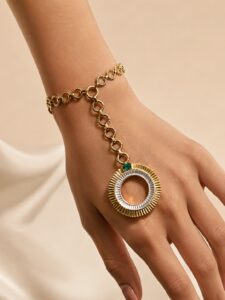
Fifteen years after its beginnings, Gemmyo affirms its model of independent jewelry
Julien VasseurMay 30, 202611 minJewelry
In the jewelry industryAge is not just a biographical detail. It's a promise of continuity, a language of trust, sometimes a marketing shortcut large heritage houses They understood this a long time ago: they rely on archives, of the aesthetic signatures and a historically codified distribution to transform a jewel as a legacy. In this landscape, we see a brand born in the era of e-commerce Claiming fifteen years of independence is not anecdotal. It is a full-scale test: that of a DNVB's ability to transform itself into a brand, to stabilize its desirability and to consolidate its economic model without diluting itself in the race for volume.
Gemmyo falls precisely within this zone of tension. Born with a digital promise and a rhetoric of "fair pricing," the brand has gradually shifted its center of gravity towards a omnichannel strategy Or the showroomThe appointment and the experience play just as crucial a role as the website. The challenge is no longer simply to buy a ring online; it's about creating a lasting relationship with the product, the service, and the associated imagery, in a sector dominated by groups capable of investing heavily in communication retail real estate and the orchestrated scarcity.
A market long dominated by heritage homes
Luxury jewelry It was built on precise codes: the address, the storefront, the ritual, and a form of symbolic verticality. Buy from Cartier, Van Cleef & Arpels, Boucheron, Chaumet, Bulgari Or Tiffany & CoIt's not just about choosing a design; it's about entering a narrative, accessing a service, and appropriating a share of collective prestige. Groups like LVMH or Richemont have reinforced these strategies by industrializing artisanal excellence, securing supply chains, and professionalizing the customer experience. Conversely, an independent brand must earn trust without the support of a century of archives or the clout of a global network. It must quickly demonstrate the quality of its execution, the legitimacy of its design, the consistency of its pricing, and the robustness of its after-sales service. In this context, the "highly codified" distribution mentioned by most observers is not simply a matter of channels; it relates to how the jewelry industry safeguards its proof of value. Independence, on the other hand, requires creating this proof day after day.
From DNVB to alternative house status
The term DNVB, For Digital Native Vertical BrandThis refers to those online-born, often vertically integrated brands that prioritize control of their supply chain and a message of transparency. In the jewelry industry, this model long seemed counterintuitive: how can you sell a diamond, a solitaire, or an 18-karat gold pendant without seeing it, without trying it on, without experiencing the interaction with a consultant? Yet, evolving purchasing behaviors and the widespread adoption of video appointments have created an opening. Fifteen years later, the question is no longer whether one can "start" digitally, but how to grow. An alternative brand, in the sense that Gemmyo approaches, must combine two forces: rationality (price, traceability, process) and irrationality (desire, emotion, projection). The balance is delicate: too much rationality, and the jewelry becomes a product; too much irrationality, and the initial promise of transparency vanishes. Consolidating an independent model therefore means holding these two poles together, without losing the clarity that gave rise to trust.
The "fair price" in jewelry: promise, education, and blind spots
The "fair price" is an appealing expression because it responds to a contemporary intuition: the consumer wants to understand what they are paying for. In jewelryThis educational approach relies on concrete elements, such as the gold purity (often 18 karats), the weight, the type of stones, the quality of the settings, the polishing, and the manufacturing time. It also involves discussing the various trades: the jeweler who shapes the piece, the setter who secures the stones, the polisher who achieves the final brilliance, and the gemologist who provides the expert appraisal. But this concept has its limits. The price of a piece of jewelry is not simply the cost of materials and labor. It includes creative research, quality control, service, potential resizing, logistics, and above all, an intangible asset: the brand. Heritage houses have built this asset over decades; an independent brand must build it at an accelerated pace, often with costly marketing investments. The "fair price" then becomes a balancing act: being accessible enough to appear honest, without becoming so "affordable" as to undermine the perception of luxury, and therefore desirability.
Omnichannel distribution: from click to appointment, from storefront to link
THE transition to omnichannel This is not a strategic affectation; it is a response to the object itself. A piece of jewelry is not an item of clothing: its size, its drape, its presence on the skin, the way a stone catches the light, often require a physical experience. The showroom then becomes a space for conversion, but also for reassurance. It allows one to handle the pieces, to compare a yellow gold setting to a white gold one, to gauge the impact of a diamond on a finger, or to appreciate the finesse of a pavé setting appointmentHe, on the other hand, reintroduces a timeless luxury. He recreates an intimacy that evokes tradition, without necessarily reproducing the intimidating ceremony of a historic boutique. For a brand like GemmyoThis evolution has direct implications for the economy: higher fixed costs, more staff training, and a more complex customer acquisition model. Where digital promised driven growth.. performance marketing, omnichannel It requires orchestration: traffic to the showroom, appointment booking, follow-up, reminders, and customer loyalty counterpart, omnichannel offers relational depth. In jewelryRepeat purchases exist: wedding rings, birthdays, births, gifts, "personal" items. A strategy that transforms an initial purchase into a long-term relationship better absorbs acquisition costs and protects independence, precisely because it reduces dependence on ever-increasing advertising costs.
Mastering the value chain: quality, deadlines and consistency in craftsmanship
The sustainability of an independent jewelry house often happens behind the scenes. Mastering the value chain doesn't mean owning everything, but rather knowing how to manage it all: design, prototyping, workshop selection, tolerance control, inventory management, and finishing standards. In jewelry, quality isn't just visible to the naked eye; it's felt. A well-executed setting protects the stone, a balanced mount ensures comfort, a mirror polish reveals the light, and a precise fit prevents premature wear. Independence also demands discipline regarding deadlines. Jewelry often lies at the intersection of gift-giving and ritual: a marriage proposal, a celebration, a date that won't be postponed. Meeting a deadline isn't a mere operational detail; it's an act of respect, and therefore a factor in building trust. Here, the brand is judged as much by its creations as by its service capabilities. Resizing, replacing a stone, checking a setting, and maintaining a platinum or gold piece are moments when the promise becomes tangible.
Traceability, CSR and new expectations: ethics is becoming a component of luxury
THE contemporary luxury can no longer ignore questions of origin. Recycled gold, responsible gold, certification, traceability diamondsCompliance with the Kimberley Process, transparency regarding workshops: these topics are now expected, especially by clients who wish to reconcile desire and conscience CSR, For Corporate Social ResponsibilityTraceability isn't just a layer of communication; it's a requirement for consistency that can become a competitive advantage for an agile, independent jeweler. For a brand born with a commitment to transparency, traceability is a natural fit. It allows for truthful communication: explaining what a certified diamond means, what a choice of metal entails, how sourcing is approached, and why certain options are more expensive. The challenge, however, is to avoid the pitfall of simplistic "all-green" approaches. Informed consumers know that the impact is multifaceted: extraction or recycling, transportation, lifespan, repairability, and the ability to pass the jewelry down through generations. A company that structures its service and guarantees inherently strengthens this sustainable dimension.
Lab-grown and natural stones: trade-offs, perception and desirability
There synthetic diamond rise, often called lab-grownThis is reshaping the market. These are lab-grown diamonds with physical properties identical to natural diamonds, but a different history. Their widespread availability is driven by two factors: increased accessibility of comparable size and quality, and some ethical concerns. Meanwhile, natural diamonds retain an aura linked to geological rarity and tradition, supported by a resale value that is more readily understood in the public imagination an independent brandThe subject is strategic because it touches on the heart of the value proposition. The important thing is not to make a dogmatic decision, but to clarify. What uses, what budgets, what emotional expectations? One engagement ring It doesn't carry the same symbolic weight as a fashion statement or an everyday piece of jewelry. Education must also cover other gemstones: sapphires, rubies, emeralds, tourmalines, and the diversity of possible treatments. In all cases, desirability is built through design, quality of craftsmanship, and the narrative conveyed by the material, whether natural or lab-created.
Raw material inflation: how to defend a price positioning?
In recent years, rising raw material prices have put the jewelry industry under pressure: increased gold prices, fluctuating gemstone prices, energy costs, and strain on skilled labor. For an independent jewelry house, the challenge is twofold. First, how to maintain consistent pricing without compromising quality? Second, how to explain a price increase without breaking the relationship of trust built on transparency? The answer lies in the product range architecture and clear decision-making. A brand can, for example, adjust the thickness of its rings, optimize certain volumes without sacrificing durability, or offer different center stone sizes while maintaining a signature setting. It can also invest in timeless designs, whose longevity better absorbs occasional price increases. Finally, it can enhance service and support, so that price is perceived not as a barrier, but as the value of a complete experience: advice, fitting, personalization, and maintenance.
Branding and icons: from awareness to attachment
Jewelry It lives on symbols. The shape of a setting, the profile of a solitaire, the way a pavé setting creates a halo, all become emotional touchstones. Major houses have their icons; an independent house must create its own, without imitating. This is where branding takes on an artisanal dimension: repeating an aesthetic intention, refining proportions, establishing a recognizable signature. Desirability arises when a piece of jewelry is identifiable from afar, not by an ostentatious logo, but by the clarity of its lines. The ceditorial content, THE campaigns, there photographyThe way in which a workshop or a gesture is described also contributes to this construction.
Julien Vasseur writes about gastronomy, travel, and great places with a simple and curious perspective. He enjoys highlighting locations, restaurants, and experiences…