A strong signal: technology is no longer just a passing fad
Burberry and Premium Athleisure: The Bet on Luxury in Motion – When Burberry formalized theintegration of technical clothing into its offering, the move went beyond a mere opportunistic capsule collection. It marked the British fashion house's entry into a phase where functionality once again became a central argument for luxury apparel: protection from the elements, freedom of movement, and versatility from morning to night. For Burberry, whoseDNA is historically linked toouterwear andtextile innovation,premium athleisure appeared as a logical extension, but also as a strategic test: can the brand attract new customers without losing its distinctiveness, and can it claim legitimacy in the face of performance specialists?
Understanding high-end athleisure: a promise of hybridization

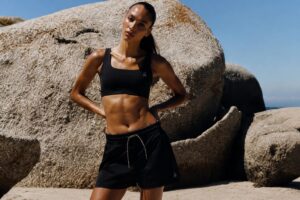
The term "high-end athleisure" refers to a sportswear-inspired wardrobe designed for urban wear, with cut, fabric, and finish standards that align with luxury codes. It's not simply about wearing expensive tracksuits ; the key lies in hybridization. A jacket might borrow heat-sealed seams and a waterproof zipper from mountaineering gear , while maintaining a clean line , a refined collar , and an elegant color palette . Trousers might evoke tailoring in their construction but incorporate an ergonomic waistband, subtle stretch, and abrasion resistance. At the heart of this segment lies the concept of a garment that is "ready to live in": comfortable, mobile, and reliable. The rise of this category reflects a lasting reality: part-time remote work, more frequent travel, and the acceptance of relaxed silhouettes in settings that were once more formal.
Why is Burberry arriving at the right time, but in a demanding field?
Timing is everything.Premium athleisure has emerged in successive waves: first as a response to the need for comfort, then as a sign of a more pragmatic luxury, and finally as a cultural marker fueled by social media and new urban lifestyles. Burberry chose to invest in the segment just as the market was becoming more structured: consumers compare products, understand materials, recognize membranes, and expect credible performance. The competition is no longer just from traditional fashion houses, but also from players born in theoutdoor and running sectors, capable of demonstrating their expertise through testing, patents, and product engineering. For Burberry, the opportunity is real: the brand can capitalize on its history of coats and raincoats, and its long-standing connection to protection and the British climate. But the playing field is demanding, because the slightest broken technical promise will cost the brand its reputation.
Technical clothing: a product culture shift
Moving from " beautiful " to " beautiful performance " alters the decision-making process. Technical clothing involves precise choices of materials and components: ripstop nylon, softshell, merino wool, breathable linings, durable water repellent (DWR) treatments, waterproof zippers, and welded seams. It requires a longer development process, prototypes, and tests for durability, pilling, wash resistance, and breathability. It demands expertise from professionals sometimes less visible in the fashion world: textile engineers, quality technicians, material developers, and experts in functional pattern making. For a brand like Burberry, the challenge is not simply to add "sports" pieces to the lookbook, but to establish rigorous performance standards without losing the luxury touch: the feel of the fabric, the drape, the precision of the finishes, and the harmony of the silhouettes. This product culture, if well executed, can become a lasting competitive advantage.
Customer expansion: attracting without confusing
Premium athleisure is a powerful recruitment tool. It appeals to younger, urban customers who juggle meetings, travel, and gym sessions, and who want to invest in pieces that can handle it all. It also attracts buyers already familiar with luxury but tired of a wardrobe that's too fragile or too "casual." For Burberry , this expansion isn't limited to age; it extends to how the brand is used. A technical down jacket, a water-repellent overshirt, a performance sneaker, or a merino knit set can be less intimidating entry points than an iconic trench coat. The risk is blurring the lines if the offering becomes diluted into indistinct sportswear. Success will depend on a clear hierarchy: functional pieces that remain instantly recognizable as Burberry, through their cut, color palette, a check detail, or a discreet signature, rather than an omnipresent logo.
Repositioning and narrative: functional luxury as an extension of heritage
The battle is also being fought in the narrative. Burberry doesn't need to invent legitimacy out of thin air: the house was built on outerwear, on the idea of protection from the elements, on a certain vision of functional elegance. The challenge lies in translating this heritage into contemporary language without falling into decorative archiving. Use-oriented luxury doesn't mean "utilitarian" luxury in the raw sense; it means luxury capable of solving problems with grace. In this logic, technicality becomes a source of desire, provided it is explained precisely: why this membrane, why this construction, what concrete benefit does it offer when worn? Today's consumers, especially in the premium segment, are receptive to evidence. They expect simple explanations, tangible results, and consistency between words and experience.
Facing the performance-luxury specialists: the battle for credibility
The segment is already occupied by brands that have built their reputation on performance. Arc'teryx, Salomon, The North Face, Canada Goose , and Stone Island have communities capable of recognizing a garment designed for practical use and of rejecting cosmetic "techwear." At the other end of the spectrum, brands like Prada with Linea Rossa, Moncler and its various lines, as well as initiatives combining luxury and sport, have already familiarized the public with a hybrid aesthetic. Burberry is therefore entering an arena where the codes are well-established. To be credible, the brand will have to choose its focus: urban performance and travel, climate protection, intelligent layering, rather than pure competition. A jacket that excels in rain and wind, a coat that combines insulation and lightness, an outfit that breathes in movement: these are promises compatible with Burberry's DNA and sufficiently "technical" to convince.
Price, margins and perceived value: the delicate equation of technology
Pricing athleisure is a delicate balancing act. Technical fabrics and quality components are expensive, R&D and testing increase production costs, and construction can be more complex than for a standard garment. Yet, consumers compare it to performance brands whose prices, while premium, can still be lower than those of a luxury fashion house. Burberry must therefore build a clear perceived value: design, fit, durability, service, retail experience, prestige, but also demonstrable performance. Otherwise, the risk is being caught between two worlds: too expensive to be chosen as gear, not "exceptional" enough to justify the price as a fashion item. The solution often lies in a range structure: credible entry-level pieces, and more elaborate pieces where technical expertise meets craftsmanship in finishing, linings, and details, which truly makes the difference.
Distribution: physical stores, e-commerce, and the role of retailers
Distribution plays a significant role in the perception of technical aspects. In stores, premium athleisure sells when the customer can touch the fabric, manipulate a zipper, understand a ventilation system, try on a hood, and move their arms. The salesperson's presentation becomes essential, as do the store layout and merchandising , which must avoid the "sports department" effect while remaining easily understandable. In e-commerce, the educational approach must be even more precise: detailed product descriptions , macro photos , movement videos , and explanations of the benefits. Multi-brand retailers , for their part, play a prescriptive role, especially when they specialize in premium outdoor or high-end streetwear. But they also impose their own rules: strict selection, direct comparisons, and stock rotation. For Burberry, the challenge is to control its image while accepting that technical credibility is also built by being present in the right place, among recognized brands.
Collaborations and capsules: accelerating without getting lost
In premium athleisure, collaboration has become a classic accelerator: it provides technical credibility, an audience, and a surge in demand. Burberry might be tempted to partner with a performance brand or a materials laboratory to gain credibility. But collaboration isn't a magic bullet. It can be a flash in the pan, divert attention from the core collection, or create the impression that the brand can't do things on its own. The challenge is to choose partnerships that reinforce the brand's DNA rather than disguise it: collaborations on innovative fabrics, low-impact dyes, more sustainable components, or functional tailoring expertise. The capsule collection must then function as a demonstration, not a disguise, leaving a lasting mark on the permanent collections.
Materials innovation and responsibility: performance expected on all levels
Technical clothing is being scrutinized on another front: that of impact. Certain membranes, water-repellent treatments, glues, and coatings have been criticized for their persistent substances. The premium consumer, without being a chemistry expert, wants guarantees, progress, and transparency. Burberry, like other brands, must reconcile performance and responsibility: selecting alternatives, improving repairability, offering maintenance services, and considering end-of-life. In high-end athleisure, durability is not just a moral argument; it's a dimension of quality. A technical garment must last, retain its properties, and withstand the seasons without losing its shape. Luxury , in its most contemporary form, aligns itself here with a simple requirement: buy less, but better, and be able to rely on what you wear, rain or shine, even after a lot of walking.
The risk of brand dilution: how to keep Burberry instantly recognizable
Each foray into an adjacent segment exposes a brand to dilution. In premium athleisure, uniformity threatens: the same oversized cuts, the same matte synthetic fabrics, the same utilitarian codes. For Burberry, protection lies in imposing aesthetic and narrative safeguards.Iconic outerwear can serve as a compass: clean lines, a sense of proportion, British elegance, understated sophistication. The check, if used, must remain punctuation, not a design substitute. Color can play a role: elegant neutrals, controlled accents, overall coherence. Finally, the quality of construction must remain a hallmark: linings, clean finishes, precise seams, balanced proportions. A technical garment is not defined solely by its performance specifications; in luxury, it is judged from ten centimeters as well as from ten meters away.
What the customer is really buying: a style solution, not just a product
The success of high-end athleisure hinges on a simple truth: the customer isn't just buying a water-repellent jacket; they're buying a lifestyle. They want to be able to leave early, tackle a busy day, travel light, and withstand temperature changes without sacrificing style. They want pieces that work with tailoring, premium denim, and fine knits, not just -to-toe sportswear. Burberry, therefore, must offer complete silhouettes where technical features are seamlessly integrated into familiar shapes: a coat that can replace a trench coat on certain days, an overshirt that serves as a mid-layer, trousers that can be worn over a shirt, and sneakers that maintain a refined look. Service is also crucial: care advice, repairs, product availability, and a seamless returns experience. In functional luxury, excellence doesn't end at the checkout.
A full-scale strategic test: three success criteria
forayinto premium athleisure will be judged on concrete criteria. First, coherence: the technical line must integrate seamlessly into the brand's universe, engaging in a dialogue with heritage pieces, rather than existing in isolation. Second, credibility: the promised performance must be delivered, both in materials and construction, or it will face unfavorable comparisons with specialists. Finally, desirability: the product must create a desire that transcends mere functionality, through its cut, silhouette, feel on the skin, and refined details. If these three dimensions align, Burberry can transform a trend into a driver of sustainable growth, strengthen its position in contemporary outerwear, and appeal to a generation that demands luxury capable of keeping pace. Otherwise, athleisure will remain a fleeting, costly endeavor that will be detrimental to the brand's image.