At Oscar de la Renta, changes in artistic direction always go beyond the simple question of creative casting. They involve the delicate balance between heritage, desirability, expertise, and image renewal. The departure of Laura Kim and Fernando Garcia in February 2026 is therefore much more than the end of a collaboration: it closes one of the longest chapters in the house's recent history.
For nearly nine years, the duo worked to preserve what makes Oscar de la Renta unique — spectacular evening gowns, sophisticated femininity, embroidery, flowers, colors and American elegance — while loosening the codes to better integrate them into contemporary fashion.
The announcement of their departure was made public on September 17, 2025. Their objective was clear: to regain more freedom to devote themselves to Monse , the brand they had founded together in 2015. Their Fall 2026 collection , unveiled in February 2026, thus constitutes their true creative epilogue at Oscar de la Renta.
From the Oscar de la Renta studio to creative direction
Laura Kim and Fernando Garcia's relationship with Oscar de la Renta was never like that of artistic directors recruited from outside to cause a break. Both had grown professionally within the house.
Laura Kim joined Oscar de la Renta in 2003, still a student, before rising through the ranks to become design director. Fernando Garcia arrived a few years later as an intern and also worked at the heart of the studio. This intimate knowledge of the workshop largely explains their future ability to transform the brand without giving the impression of erasing its identity.
After leaving home, they launched Monse in 2015, a New York label built around a more deconstructed, edgy and experimental aesthetic.
But in September 2016, Oscar de la Renta brought them back. The duo was appointed head of design after Peter Copping. They then inherited the ready-to-wear, accessories, bridal, and children's collections. The challenge was considerable: how to evolve a house founded in 1965 without turning its heritage into a museum?
Nine years to modernize Oscar de la Renta without erasing its DNA
Laura Kim and Fernando Garcia have chosen evolutionary continuity rather than revolution. Their work retains the pillars of Oscar de la Renta: a sense of glamour, garment construction, luminous colors, floral motifs, cocktail dresses, eveningwear, embroidery, and sophisticated materials.
But the silhouette is changing. It often becomes more fluid, more graphic, and less ceremonial. Some dresses gain in lightness. The interplay of volumes becomes more spontaneous. Tailoring takes center stage. Transparency, unexpected cuts, and combinations of materials gradually move the house away from a vision too exclusively associated with the formal gown.
This evolution was essential to keep Oscar de la Renta in an industry where heritage alone is no longer enough. As illustrated by the current transformations of major fashion houses and Fashion Weeks, a luxury brand today must simultaneously defend a silhouette, a history, a digital image, and an ability to generate conversation.
The flower, a true visual language of the Kim Garcia era
It is impossible to understand their heritage without looking at the flowers.
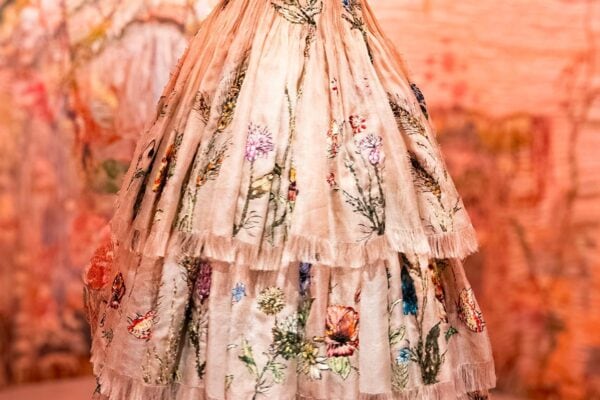
Under Laura Kim and Fernando Garcia, the floral motif is not simply a romantic print. It becomes almost a grammar of the house, worked through embroidery, appliqué, leather, painting, crochet, sequins or three-dimensional constructions.
The Spring 2025 collection , for example, used the rose as its main motif, with stems hand-painted by Fernando Garcia. In Autumn 2025, the tree peony, in turn, structured part of the season's visual vocabulary. For Spring 2026, porcelain flowers, vines, crochet, and embroidery transformed textile surfaces into veritable gardens.
This work also explains the special place occupied by Oscar de la Renta in the formal and red carpet wardrobe : the house knows how to produce an immediately spectacular image without sacrificing the legibility of the garment.
This positioning contributes to the brand's international visibility in the same way as catwalks or campaigns.
Pre-Fall 2026: A very personal return to Dominican roots
Before their final Fall 2026 collection, Laura Kim and Fernando Garcia have created a Pre-Fall 2026 . The collection pays homage to Oscar de la Renta's Dominican roots and to Santo Domingo. The house notably features hand-painted landscapes, the Fortaleza Ozama, and the designer's residence in Punta Cana.
The palm tree becomes a central motif. It appears in prints, three-dimensional embroidery, raffia intarsia, and beaded compositions. Flowers originating from the Dominican Republic also feature in the ready-to-wear, while tamarind, khaki, paprika, olive, and gold tones lend the collection a distinctive warmth. It's hard not to see it as a nod to heritage.
Just weeks before their departure, the two designers are not only looking to produce an attractive collection. They are returning to the founder's geographical and emotional roots.
It is an elegant way of reminding us that a luxury brand is not simply a succession of trends: it is based on imagination, places, gestures and memory.
Fall 2026: the latest collection from Laura Kim and Fernando Garcia
Then comes Fall 2026, their final chapter. The house presents it around three concepts: texture, proportions, and emblematic flowers. Tulips, poppies, hydrangeas, and peonies unfold at different scales, from embroidered cardigans to grand evening silhouettes in mikado and satin.
Tailoring also continues the game of textile illusion: an ultra-light wool is worked to evoke denim, while heathered prints modify their perception when the garment is in motion.
For the evening, a backless dress with a peony motif in cut thread, finished with a voluminous flounced skirt, encapsulates part of the aesthetic developed by the duo: technical mastery, theatricality, and visual lightness. Maple leaves then appear in the form of embroidery, crystals, and landscape effects.
This latest collection, therefore, does not function as a manifesto of rupture. It is more like a synthesis. Flowers, textile expertise, movement, colors, embroidery, volumes and eveningwear : the codes accumulated over nine years are brought together one last time.
The red carpet, another strategic battleground for Oscar de la Renta
Modernizing Oscar de la Renta also meant keeping the brand relevant to contemporary visual culture. Formal dresses have long been one of the house's natural territories. Under Kim and Garcia, this expertise continued to find a powerful following among actresses, singers, and public figures.
In 2023, Naomi Watts chose an Oscar de la Renta dress from the Pre-Fall collection for her New York wedding. Madame Figaro highlighted how Laura Kim and Fernando Garcia had refreshed the house's historic chic by transposing couture-inspired techniques into a luxury ready-to-wear aesthetic . The stakes, of course, go beyond celebrity itself.
In the luxury sector, a red carpet appearance transforms a dress into a media platform. The garment circulates instantly between press outlets, social networks, Google searches, stylists' accounts, and inspiration platforms. Art direction thus becomes inseparable from the brand image strategy.
Monse: Why Laura Kim and Fernando Garcia chose to leave
Their departure does not correspond to a disappearance from the fashion scene. On the contrary.
Laura Kim and Fernando Garcia have announced that they want to focus their efforts on Monse, their independent label created in 2015. The label is based on a much freer identity: deconstructed tailoring, asymmetries, reinterpreted shirts, plays on proportions and a permanent tension between classic clothing and unexpected gesture.
For several years, the two designers therefore evolved between two worlds: the sophisticated legacy of Oscar de la Renta on one side and the experimental energy of Monse on the other.
In 2025, Monse celebrated its tenth anniversary. The decision to redirect their energy towards their own brand thus appears to be as much an entrepreneurial as a creative one. Vogue France and FashionNetwork both confirmed that this desire to dedicate themselves entirely to Monse was at the heart of their new professional chapter.
Oscar de la Renta after Kim and Garcia: a succession under scrutiny
The question is now strategic: who will design Oscar de la Renta's next cycle? When his departure was announced in September 2025, no successor had been named. In February 2026, at the time of the duo's final collection, the topic remained open in the specialized press.
One element is particularly interesting in August 2026: on its official Pre-Spring 2027, Oscar de la Renta presents the collection without mentioning Laura Kim and Fernando Garcia, unlike previous seasons, but also without crediting a new artistic director. It would therefore be premature to publicly assign the house to a successor without an explicit announcement.
This transition is reminiscent of other recent changes analyzed on Luxe Daily, such as Guillaume Henry's departure from Patou or the new artistic direction of Courrèges. In contemporary luxury, the choice of an artistic director now involves not only brand creation but also brand positioning, desirability, merchandising, and communication.
What's next for Oscar de la Renta?
Three issues now seem essential. First, to preserve the immediately identifiable codes : evening, flowers, color, femininity and a certain idea of American elegance.
Next, continue to modernize the silhouette. A heritage house cannot simply reproduce its archives. As we also see at Dior, each new creative cycle must solve the same equation: respect a historical vocabulary while giving the public a reason to look forward to the next season.
Finally, Oscar de la Renta must maintain its authority in extremely competitive areas: evening gowns, bridal wear, premium women's ready-to-wear, accessories, and celebrity dressing. The post-Kim Garcia era will therefore be less about aesthetic rupture than about finding the right balance.
Laura Kim and Fernando Garcia: what legacy at Oscar de la Renta?
Their nine-year achievements go far beyond a few strong collections. Above all, Laura Kim and Fernando Garcia have demonstrated that it is possible to evolve a heritage brand without erasing its founder.
They retained Oscar de la Renta's decorative power but imbued it with greater dynamism. They protected the evening gown while simultaneously strengthening daywear and tailoring. They explored floral motifs, transforming them into a textile language. They employed embroidery, appliqué, leather, crochet, crystal, and prints as tools to renew an aesthetic without distorting its essence. The house's official collections particularly document this continuity between craftsmanship and modernization.
Their success may lie precisely there: when you look at their latest collection, Oscar de la Renta remains instantly recognizable. But the house is no longer exactly the one they inherited in 2016.
One chapter closes, two stories continue
The departure of Laura Kim and Fernando Garcia from Oscar de la Renta is less an ending than a passing of the torch. For the duo, the future now lies with Monse, with the opportunity to focus their time, energy, and strategy on a brand whose identity they directly control.
For Oscar de la Renta, the challenge is different: to transform nine years of successful continuity into the starting point for a new vision. The house possesses a particularly solid heritage for this: a generous conception of femininity, a culture of color, expertise in formal wear, and a relationship to craftsmanship that far transcends changes in artistic direction.
Laura Kim and Fernando Garcia are therefore leaving the creative side, but not the history of Oscar de la Renta. Their collections will remain as a demonstration of what luxury does best when it finds the right balance: evolving heritage without disguising it as nostalgia.
To follow more broadly the transformations of the sector, the new artistic directions and the houses that are redefining their codes, check out the Luxury Fashion section of Luxe Daily.
Frequently asked questions about Laura Kim, Fernando Garcia and Oscar de la Renta
When did Laura Kim and Fernando Garcia leave Oscar de la Renta?
Their departure was announced on September 17, 2025.They then completed their work for the house with the Fall 2026, presented in February 2026.
Since when had they been directing the creative direction of Oscar de la Renta?
Laura Kim and Fernando Garcia were appointed co-creative directors in September 2016, following the departure of Peter Copping. Their first collection under this new leadership was prepared for the Autumn/Winter 2017-2018 season.
Why did Laura Kim and Fernando Garcia leave Oscar de la Renta?
The duo now wish to devote their work fully to Monse, the brand they founded in 2015 and developed alongside their responsibilities at Oscar de la Renta.
Who replaces Laura Kim and Fernando Garcia at Oscar de la Renta?
As of this update, recent public pages on Oscar de la Renta's website, particularly the one dedicated to Pre-Spring 2027, no longer credit the duo but also do not name a new creative director. Therefore, a formal announcement from the company is necessary before attributing the succession to a specific designer.
Verified sources
Official primary source
- Oscar de la Renta – Fall 2026 : official presentation of the last collection of the Laura Kim and Fernando Garcia era, with details of materials, floral patterns, silhouettes and techniques used.
- Oscar de la Renta – Pre-Fall 2026 : collection dedicated to the Dominican roots of the house and the heritage of Santo Domingo.
- MONSE – Our Story : official presentation of the house founded by Laura Kim and Fernando Garcia.
3 French reference sources
- Vogue France – “Laura Kim and Fernando Garcia leave Oscar de la Renta”
- FashionNetwork France – “Laura Kim and Fernando Garcia will leave their positions as artistic directors of Oscar de la Renta”
- Madame Figaro – “Oscar de la Renta confirms the arrival of the duo Laura Kim and Fernando Garcia”